
Some of the built-in features of Chrome include prefetch slowdown on Windows 11/10 PCs. If you often encounter this issue, it’s time to disable some prefetch options. You can also find out which tab is causing the problem. Check out tips to fix Chrome’s high Disk or CPU usage in Windows 11/10.
100% disk usage in Windows is one of the most common issues, and there are multiple reasons. Technically speaking, it’s one of the programs that takes a heavy toll on the computer, slowing everything else down.
Fix Chrome high CPU or Disk usage on Windows PC
If you are facing high CPU or Disk usage issues in Chrome, you need to take a look at the following areas:
- Disable or remove unwanted Extensions
- Close Unused Tabs
- Disable built-in features
- Use Chrome Task Manager to identify the culprit tabs
- Reset Chrome.
1] Disable or remove unwanted Extensions
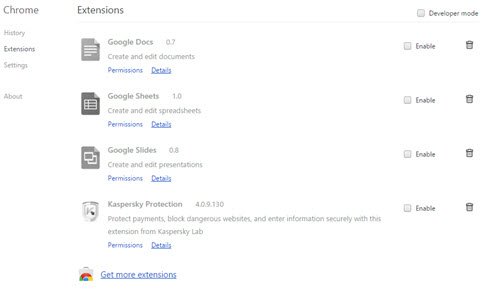
Check your installed browser extensions, themes, and addons and disable or better still remove them. Some extensions are known to consume a lot of ot resources.
Read: Fix Google Chrome lagging and slow to open.
2] Close Unused Tabs
If any tabs you are no longer using are open, try closing them and check whether resource usage decreases.
3] Disable built-in Chrome features
Google Chrome browser can cause problems if you have pinned tabs as everything is prefetched and loaded again every time you launch the browser. The only way to fix this is to disable the prefetch; otherwise, you need to unpin everything from your list, which is unlikely.
Launch Google Chrome. Go to Settings > Show Advanced Settings > Privacy.
Check for the option Use a prediction service to help complete searches and URLs typed in the address bar. Toggle it off. You can also disable the second related option, which says “Use a prediction service to load pages more quickly”
In recent versions of Chrome, this setting is called Preload pages for faster browsing and searching. You will get it under Settings > Advanced > Privacy and security.
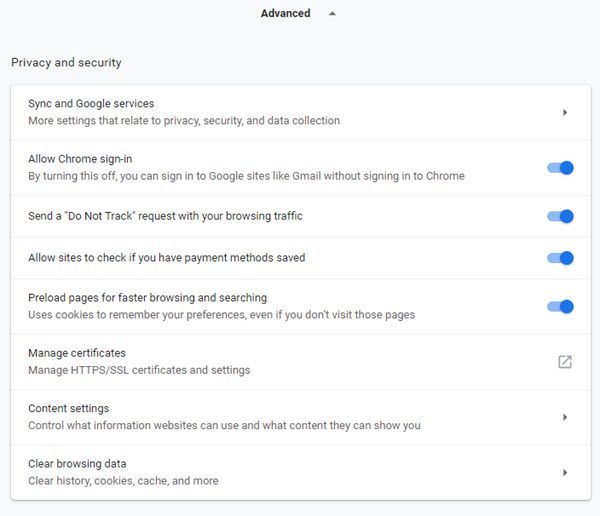
There is an advanced section called “Protect you and your device from dangerous sites.” This will cause high disk activity if either your computer is infected with a virus or has bootleg versions of Windows or Office. You can disable it for a while, but then make sure to use Windows Defender to scan your computer.
Both of these options will ensure that Chrome doesn’t download content from these sites on the go, which in turn prevents any hard disk activity. In the older version of Chrome, this was available as a prefetch.
4] Find out which Tab is using more resources
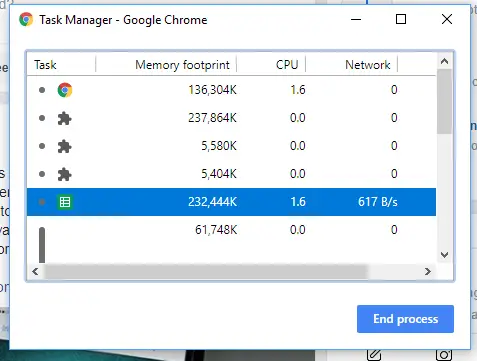
In case you don’t have many options and you need to have websites pinned, we can figure out which Tab is causing the resource usage issue in Chrome.
- Make sure Chrome is your current, and active Windows.
- Press Shift+Esc, and it will open a task manager of Chome.
- This will open Chrome’s own Task Manager, which will give you a more accurate look.
- You can see how much memory each tab and plugins are consuming. Kill the one that is causing the problem.
This will help you to figure out the problem on the go. You can always switch to another browser if this happens more often.
5] Reset Chrome
If nothing helps, you may reset Chrome – or uninstall it and then reinstall it – and see if that helps. Resetting the browser will delete personal settings, bookmarks, etc. So you may want to back them up first.
Why is Chrome taking so much memory and CPU?
The Chrome browser uses one process per tab by default. If you open the Windows Task Manager, you can see multiple Google Chrome processes. The idea behind this is that should any one of your tabs crash, it will not crash the entire browser, as each tab will have its own process running. Only that tab will crash. This results in Chrome consuming high resources. The other cause could be your Plugins.
Read: Google Chrome Helper Renderer High Memory or CPU Usage
How can I reduce Chrome memory usage?
The following suggestions can help you reduce Chrome memory usage:
- Close Unused Tabs.
- Run a Malware Scan.
- Enable Hardware Acceleration.
- Remove conflicting browser Extensions.
- Creating a new User Profile for Google Chrome.
- Disable the Site Isolation feature.
- Turn on Use a prediction service to load pages more quickly.
- Use the process-per-site switch
- Reset or Reinstall Google Chrome.
I hope this helps!
