
If you often face slow data transfer speed or the process gets stuck multiple times when you copy or transfer items to and from the external hard disk drive, then this post can be helpful. In this post, we have covered some simple solutions to increase data transfer speed in an external hard drive on Windows 11/10. After trying these solutions, instead of waiting longer than expected for the data transfer process to complete, you may see some improvements in your external hard drive data transfer process.

Increase Data Transfer Speed in External Hard Drive in Windows 11
To increase data transfer speed in your external hard drive on a Windows 11/10 computer, you can try the following solutions:
- Set Better Performance option for external hard drive
- Connect to USB 3.0/3/1 Port
- Close running programs
- Convert external hard drive to NTFS File System
- Clean up external hard drive
- Use Fast File Copy tools
- Format your external hard drive.
Let’s check all these solutions one by one.
1] Set Better Performance option for external hard drive

It is one of the effective options that can help you optimize data transfer speed in your external hard disk drive. By default, Windows OS keeps the Quick Removal (default) policy for USB or external hard drives which disables disk write caching operations which can further result in slow performance and transfer speed. But, you can change this setting to the better performance mode that can make your USB device or external hard drive perform faster and you may experience a better data transfer speed. Here are the steps:
- Open the Disk Management tool on your Windows 11/10 computer
- From the left section, right-click on your external hard disk drive
- Click on the Properties option
- In the Properties window, switch to the Policies tab
- In the Removal policy section, select the Better performance option
- Under the Write-caching policy, select the Enable write caching on the device option
- Press the OK button
- Close the Disk Management tool.
2] Connect to USB 3.0/3.1 Port
If you have a USB 3.0/3.1 external hard drive and you connect it to your system with a USB 2.0 port, it could also slow down the transfer process, as it will provide the data transfer rate of USB 2.0 only. Therefore, you should connect your hard drive with a USB 3.0/3.1 port on your system and you will see a noticeable change in the file copy or transfer speed.
Almost every modern laptop/desktop comes with a USB 3.0/3.1 port that provides faster data transfer rates. Just look for the sign/logo such as SS (SuperSpeed) or color, etc., to identify the USB3.0 port and then connect your external hard drive to it.
Related: Fix slow SSD Read or Write Speed on Windows.
3] Close running programs
If your external hard disk is engaged in multiple tasks, like downloading files to it, scanning it for viruses, watching videos, etc., then it will surely result in a slower data transfer speed. If so, give it a break and close running programs and other apps when you transfer or copy files to the external hard drive to improve transfer speed.
4] Convert external hard drive to NTFS File System
If you use your external hard drive on Windows and it uses FAT32 or exFAT file system by default, then you should change it to the NTFS file system. There is a big difference between NTFS, FAT32, and exFAT file systems. FAT32 and exFAT file systems are suitable for small USB drives, SD cards, or external drives and have their own limitations. On the other hand, NTFS (New Technology File System) is more efficient than FAT32, offers better read and write speeds, and supports large files.
Therefore, it would be good to convert your external hard disk to NTFS format so that you can have a better data transfer speed for your external hard drive. Before doing that, you must keep a backup of your external hard drive as there may be chances for data loss. Once your backup is ready, you can convert the external hard drive to the NTFS file system using an elevated Command Prompt window and executing the following command:
Convert DRIVELETTER: /fs:ntfs
Replace DRIVELETTER with the actual drive letter (like H, I, etc.) of your external hard drive to successfully execute the command. Alternatively, you can also use some free tools like EaseUS Partition Master (free edition) that supports FAT32 to NTFS conversion.
Read: External hard drive inaccessible? Format External Drive or run Check Disk.
5] Clean up external hard drive
If your external hard drive is full (little to no storage space), it can also significantly affect data transfer speed. Low storage space also makes it difficult to open and use programs, files, and other data. In addition, junk files and other data could affect your external hard drive’s performance. So, remove unwanted data and junk files. Find large files or other files on your external hard drive and then either delete them or simply transfer less important data to some other storage. Along with that, you can also use some junk cleaner software to gain some disk space as well as help optimize the disk drive.
6] Use Fast File Copy tools
The traditional file copy process in Windows OS is good enough to copy and move files. Sometimes, it is not suitable, especially when you are copying or moving data from a USB flash drive or external hard drive to your computer and vice versa. In such a case, you can use some free fast file copy software like TeraCopy available for Windows 11/10.
Also read: External Hard Drive not showing up or detected in Windows.
7] Format your external hard drive
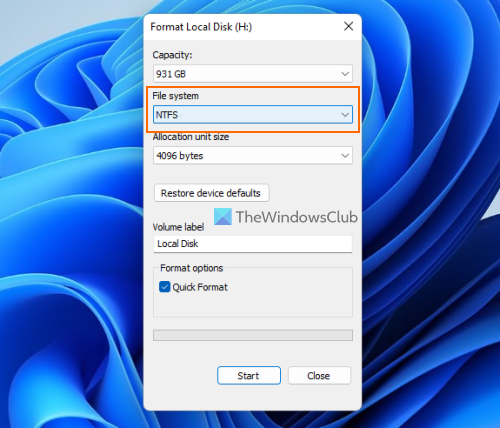
This might be the last solution to try, but you must back up your external hard drive stuff before doing this. Formatting your external hard drive will wipe all data (which might be causing slow transfer speeds), create space for new entries, and can improve performance when transferring data between your Windows 11/10 system and the external hard drive. While formatting your external hard drive, make sure to select NTFS as the File system in the Format window.
Other than these options, you can also try to defrag the hard drive, update USB drivers, perform an antivirus scan, etc.
I hope something will help you.
Why is my external hard drive transferring so slow?
The reason why your external hard drive is transferring data at a slow speed could be anything. For example, it can happen because your external hard drive is running low in storage space, it has an improper file system, bad sectors, it is connected to the wrong port (like USB 2.0 instead of USB 3.0), etc. If you have this problem pretty often, then you can convert your hard drive to NTFS, close running programs or apps, change the removal policy for the external hard drive for better performance, and try other solutions. You can read this post that includes all these fixes.
How can I speed up my slow external hard drive?
If you are experiencing a slow data transfer speed whenever you transfer files and folders to and from your external hard drive, then you can try the following solutions:
- Connect to USB 3.0 Port or 3.1 Port
- Set the best performance mode for your external hard drive
- Convert your hard drive to an NTFS format file system
- Free up the disk space, etc.
We covered all these solutions separately, with the required instructions in the post above.
Read next: How to Sync Two External Hard Drives in Windows.
