
The Search option is a great way to quickly find something from the deepest pocket of your Windows 11/10 computer. With Search Indexing turned on, it allows you to search out any file or folder using the feature in question. However, for some users, the feature isn’t working well, according to them, Start Menu Search is too slow and is hindering their productivity. In this post, we’ll discuss this issue and how to fix it.
Why is the Start menu so slow?
The Start Menu can be slow for various reasons. Usually, it’s just a glitch that a restart fixes. If it’s the File Explorer, then just restart it, if it’s the search service, restart it, since we don’t know what actually is the cause, we are going to restart all of them.
If that doesn’t work, the issue is that you are putting too much load on the Start Menu. Web search and indexing of every single file type can put a lot of load on the Start Menu.
Start Menu Search is slow in Windows 11
If the Start Menu Search bar is slow to open or if the Search operation itself is slow in Windows 11/10, try the following solutions.
- Restart Start Menu
- Restart Windows Explorer process
- Stop and Start Windows Search Service
- Run Search and Indexing Troubleshooter
- Disable Web Search using Registry
- Alter Indexing Settings or Rebuild it
Let us talk about them in detail.
1] Restart Start Menu
First, restart Start Menu and see if that helps.
2] Restart Windows Explorer process
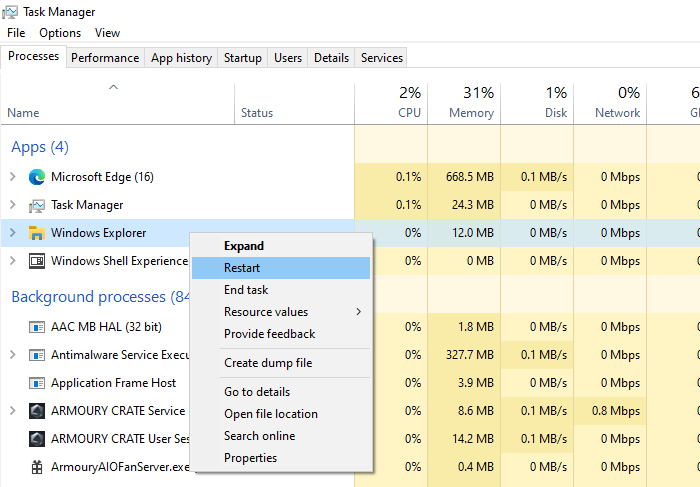
Next, try restarting File Explorer. This refreshes Explorer, the Start Menu, the taskbar, and other components, which can clear the glitch. To do this, follow the steps below.
- Open Task Manager.
- Look for File Explorer.
- Right-click on it and select Restart.
It will take a moment, but your issue should be resolved.
Read: Start Menu is very slow to open? Make it faster!
2] Stop and Start Windows Search Service
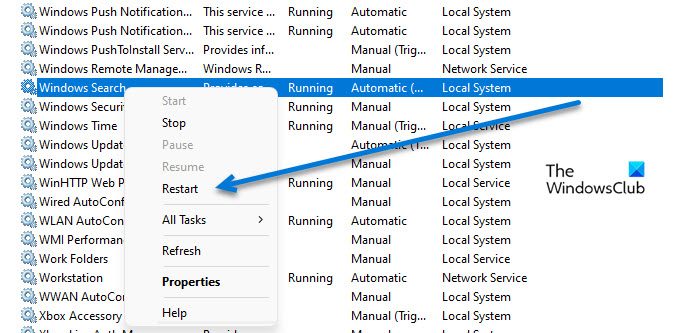
If restarting File Explorer doesn’t work, try restarting the Windows Search Service using the Services app. This will clear any glitches in the service and, hopefully, resolve the issue.
To restart the Windows Search Service, follow the prescribed steps.
- Open Services app.
- Look for Windows Search.
- Right-click on the service and select Restart.
- Close Services app.
Finally, check if Start Menu is searching quicker or not.
3] Run Search and Indexing Troubleshooter
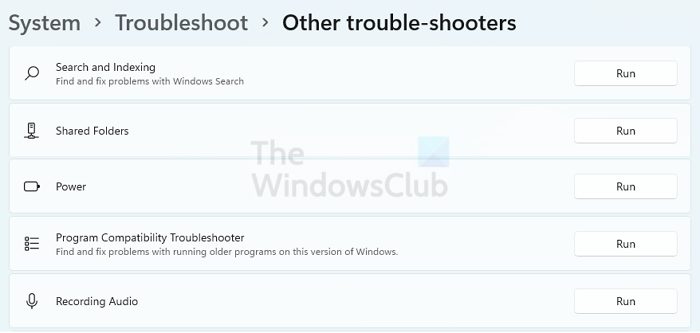
We can also try running Search and Indexing Troubleshooter and let it scan and repair any issue that your Search may have. The following are the steps to run the Search and Indexing Troubleshooter.
Windows 11
- Open Settings from the Start Menu.
- Click System > Troubleshoot > Other troubleshooters.
- Look for the Search and Indexing troubleshooter, and click on the Run button.
Windows 10
- Open Settings.
- Go to Update & Security > Additional troubleshooter.
- Click Search and Indexing > Run the troubleshooter.
Hopefully, this will do the job for you.
4] Disable Web Search using Registry
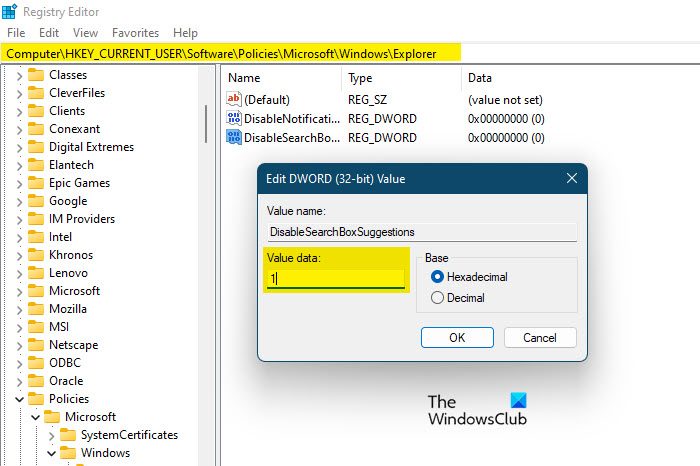
You must have noticed, that when you search for something from the Start Menu, you don’t only see searches from your computer, but also from the web. One of the reasons why Search is slow on your computer is that it searches the web for your result as well. You can actually disable it using the Registry Editor as it will make your search quicker. To do the same, open Registry Editor. You will be asked to confirm your action in UAC prompt, click Yes. Now, navigate to the following location.
Computer\HKEY_CURRENT_USER\Software\Policies\Microsoft\Windows
Now, right-click on Windows and select New > Key. Name the key Explorer.
Right-click on the newly created key, Explorer and select New > DWORD (32-bit) Value. Name it DisableSearchBoxSuggestions. Double-click on the DisableSearchBoxSuggestions value to open it, then set the Value data to 1, and click Ok.
5] Alter Indexing Settings or Rebuild it
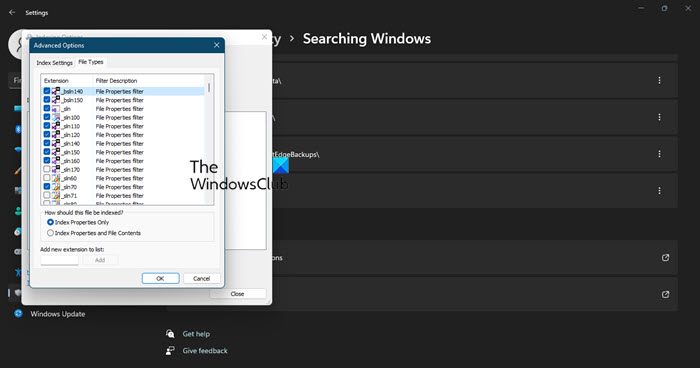
Windows built-in Search Indexing includes many file types. So, every time you type a word in the search bar and ask Windows to look for it, it searches all the included file types and takes a lot of time. If you know you won’t search for a file type using this feature, a good option is to exclude it from Indexing.
Follow the given steps to configure Search Indexing options.
- Open Settings.
- Go to Privacy & security > Searching Windows.
- Scroll down to Related settings and click on Advanced indexing options.
- Click on Advanced.
- Go to the File type tab.
- Untick a few extensions you don’t want indexed, especially ones you don’t use much.
- Click on Ok.
This should make the search process a little less cumbersome.
If changing the Indexing Options configuration doesn’t work for you, this feature may be broken. In case of that, you can easily rebuild the Search Index and resolve the issue. Follow the given steps to do the same.
- Open Settings.
- Go to Privacy & security > Searching Windows.
- Scroll down to Related settings and click on Advanced indexing options.
- Click on Advanced > Rebuild.
Hopefully, this will do the job for you.
How do I fix my Start menu search?
If the Start Menu is too slow in searching your files and folders, check the solutions mentioned in this post and resolve the issue. In case, Start Menu is not working at all, check our guide on how to fix this issue. Hopefully, you will be able to resolve the issue with either of the set of solutions.
