
If Credential Manager is not working, showing, opening, not responding, or not updating passwords in Windows 11/10, then this article will help you. You may see a Credential Manager File system error.
As far as the saving of web passwords is concerned, Credential Manager is the built-in tool in Windows 11/10, which Edge uses to store credentials. However, I have noticed that on many of the sites, they don’t provide me with the option to save credentials. Thus, for almost 60% of the sites I visit using Edge, I have to enter my login details repeatedly, session after session. In other words, this Credentials Manager feature isn’t working properly on my system – otherwise, I wouldn’t have faced such an issue.
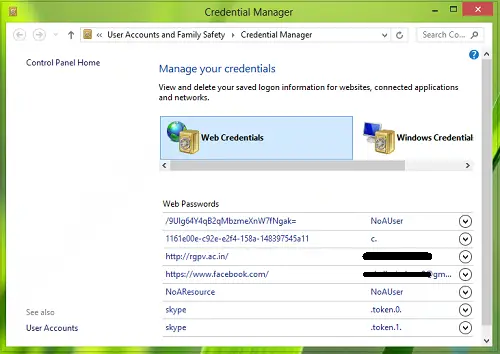
Credential Manager not opening, working or responding in Windows 11/10
So how can one fix this problem so that Credential Manager becomes fully functional again and starts saving my credentials for the sites I desire? If you’re also fed up with this issue, here are some fixes you can try to resolve it. However, first, open Services Manager and ensure that the Credential Manager service and its Dependencies are started and working properly.
Fix Credential Manager File system error
Before you begin, you might want to check for Windows Updates and run System File Checker.
1] Check Internet Properties
1. Press Windows Key + R combination, type put inetcpl.cpl in Run dialog box and hit Enter to open the Internet Properties window.
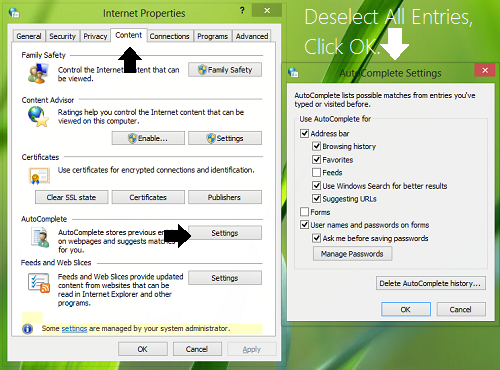
2. In the Internet Properties window, switch to the Content tab; then click Settings under AutoComplete section. Now in the AutoComplete Settings window, clear all the checked entries, click OK and then reselect the entries as selected before and again click OK. That means you have to deselect the entries there. When you’re done, reboot the machine, check the status of your problem, if it is not fixed yet; go to the next step.
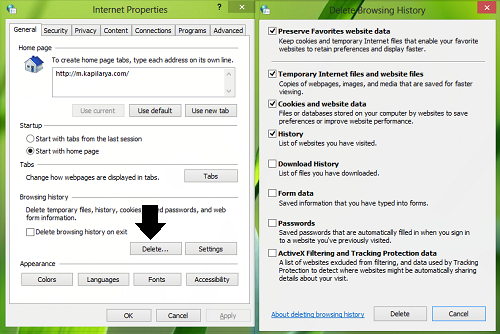
3. Now in the Internet Properties window, switch to General tab, click on the Delete button as shown below. This will open Delete Browsing History window, where you’ve to select all the options and click Delete. This will finally clear the cache, and your problem should be solved by now.
2] Using Registry Editor
1. Press Windows Key + R combination, type put Regedt32.exe in Run dialog box and hit Enter to open the Registry Editor.
2. Navigate to the following location:
HKEY_CURRENT_USER\Software\Microsoft\Internet Explorer\Main
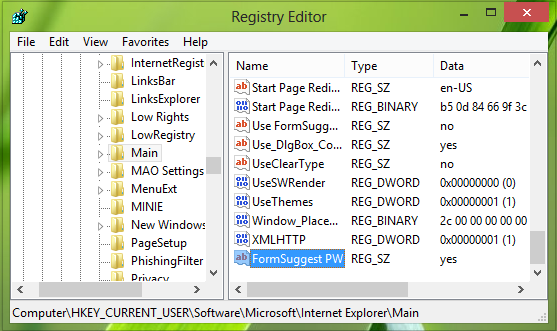
3. In the right pane of this location, look for the FormSuggest PW named string (REG_SZ). If it is not there, you can create it manually using Right-click > New > String Value. Double click on the same string to modify its Value data:
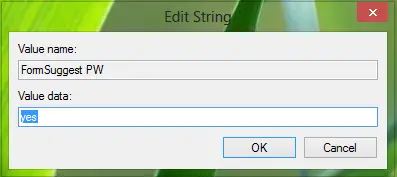
4. In the above-shown box, set the Value data to yes and click OK. You may now close the Registry Editor and reboot to get results.
3] Restart these Windows Services
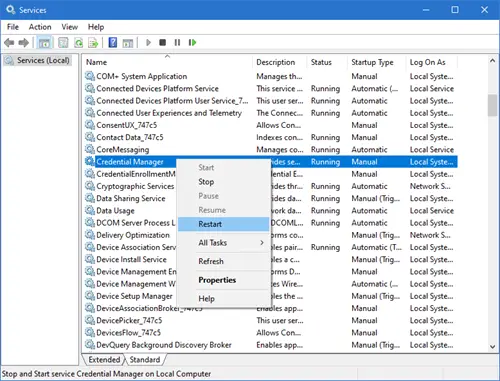
Open Services Manager and ensure that the following Services are started. If they are already running, Restart them.
- Credential Manager
- CredentialEnrollmentManagerUserSvc
- Remote Protocol Call.
4] Delete the contents of the Protect folder
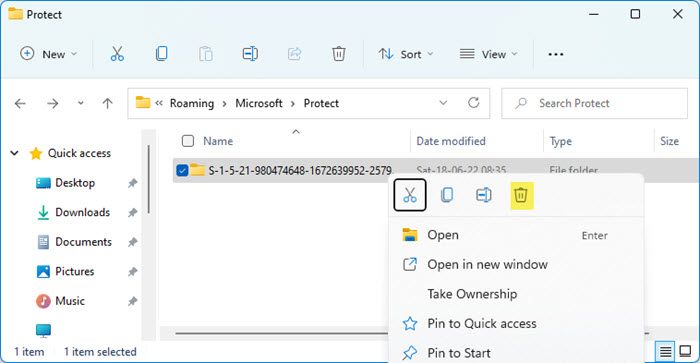
Navigate to the following location in Explorer:
C:\Users\<username>\AppData\Roaming\Microsoft\Protect
All encrypted caches are stored in this directory. Delete the contents of the Protect folder. When you do this, all the saved credentials and other encrypted data will be lost. By doing this we reset the encrypted cache folder.
You may back up this folder and its content to another location in case you wish to restore it here and create a system restore point as well.
Restart your computer and see if this resolves the issue.
5] Enter credentials manually a few times and see
If the Credential Manager is not working properly, try entering your credentials manually a few times to see if that helps in the long run.
- Open Credential Manager
- Select Windows Credentials
- Click on Add a generic credential
- Enter the required details
- Click on OK and exit.
6] Change saved passwords in Credential Manager via Edge
- Open Microsoft Edge browser
- Click the Menu button in the top right corner
- Choose Settings from the menu.
- Locate Advanced settings and click on View advanced settings.
- Scroll down to Privacy and services and click on Manage passwords.
- Click on any saved password to change it.
- Make the changes and click on Save.
Hope this helps.
How do I fix network credentials in Windows 11?
To resolve the issue, you need to modify or update the Advanced Sharing settings on your Windows 11 or Windows 10 PC. Apart from that, you can use Microsoft account credentials as well. However, if it doesn’t work, you can manually add the credentials of the target PC to the respective credential manager.
How do I open Credential Manager in Windows 11?
Opening the Credential Manager on Windows 11/10 PC is easy. You can click on the Taskbar search box, type credential manager, and press the Enter button. It will open the Credential Manager on your computer. Apart from that, you can open the Control Panel and open the Credential Manager, respectively.
Related reads:
