
Every time we visit a website, we get a pop-up asking for permission to improve our browsing experience, and most of the time we give permission very readily. We don’t really care that we are permitting them to collect our data, track our location, use our microphone or camera, etc. Undoubtedly, these permissions improve our experience on these websites, but they come with many security and privacy risks.
In this post, we will talk about how to understand the risks involved and manage Website Permissions to stay safe and protect your privacy online. It’s pretty easy actually. With just a few little changes in Chrome, you can easily manage the permissions you have given to each website.
How to manage Website Permissions in Chrome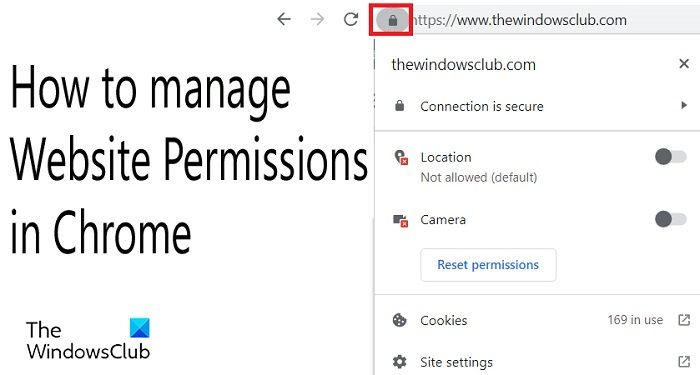
With a few tweaks in your Chrome browser settings, you can manage website permissions.
Open Chrome on your PC and go to the three-dot menu in the top-right corner of your browser.
Go to the Settings section.

Chrome will open a new settings page with various sections.
In the left panel, go to Privacy and Security.
Scroll down and go to Site Settings in the right panel.

Here you can see the permissions you have granted to various websites and also can change the settings for further management.

When you click on the option saying, “View permissions and data stored across the sites”, it will open the whole list of websites storing your data. Trust me, you will be shocked to see how many websites actually have your permission to store your data. I myself was shocked when I checked it while writing this post. Intentionally and sometimes unintentionally, we give so many websites to store our data which is not safe at all. 
Well, now that you know about the websites having your permissions, you can clear the data and reset the permissions from here. You can clear the entire data by clicking on the Clear Data button too. When you clear data for a website, you will be logged out from the site and all your offline data will be cleared.

If you don’t want to clear the data, you should at least check and “Reset Permissions”.
Click on the tiny arrow in front of the website and you will see the options to reset permissions. 
Here, you can also check the permissions you have already given to a certain website and reset it.
Don’t allow sites to ask for your permission
Almost every website asks for your permission to use your camera, microphone, location, sound, and many more things as you can see in the screenshot above. Thankfully, Chrome allows us to adjust these settings and not allow the websites to even ask for these permissions.

Go to the Permissions section in the Site Settings and adjust the settings one by one. Click on Location and check the box, ‘Don’t allow sites to see your location’. You can also change settings for the camera, microphone, sound, etc. Once you are done, sites will automatically follow these new settings.
Additional Permissions
Under the Additional Permissions section, you can adjust the settings for motion sensors, USB devices, protocol handlers, file editing, and much more. To change the settings, click the tiny arrow next to each permission.
Change settings for a particular website
To manage permissions for a particular website, you can do so directly from the website itself. Open the website you want to manage permissions for, then click the small lock icon in the URL.
Here, you can see whether Location is allowed, or you can go directly to Site Settings to check.
Read: How to best protect your Privacy on the Internet.
How do I check permissions on my browser?
Click on the three-dot menu in the top-right corner, go to Settings > Privacy & Security > Site Settings > Permissions. Here you can check and manage all the permissions given to various websites.
Where are the site settings in Chrome?
You can go to Site Settings directly by clicking the lock icon in your URL, or via Settings. Click on the Kebab menu (three dots menu) on the top right corner of Chrome and go to Settings. Under the section Privacy and Security, you will find the Site Settings.
