
Windows 11 has a new taskbar that differs significantly from the one in Windows 10 and other older versions of the operating system.
The taskbar here looks similar to what you might find on a Mac because it is centered by default. We must admit that while this version of the taskbar is quite the looker, it loses some functionality, which is unfortunate.
Some of the features the Windows 11 taskbar has lost
Windows 11 Taskbar has lost many features. You can’t move the taskbar to the side or above, so it is permanently fixed to the bottom of your screen. Additionally, the search button is no longer located there. You must first click the Start button to access it. We suspect that as time goes by, Microsoft will bring back some of the old features in order to make the taskbar more useful than it is right now.
How to customize the Windows 11 taskbar
Customizing the taskbar on Windows 11 is easier than you might think. The following information should turn you into an expert, so keep reading.
- How to pin an app to the Windows 11 taskbar
- Remove pinned apps and icons from the Windows 11 taskbar
- Move the taskbar icons to the left
- Show or Hide Taskbar corner icons in Windows 11
- Change Taskbar position in Windows 11
- Change Taskbar size in Windows 11
- Show or hide Taskbar buttons
- Show or hide additional system tray icons
- Show or hide time and date in the Taskbar system tray
- Auto-hide the Taskbar in Windows 11
- Prevent changing Taskbar size in Windows 11
- Prevent changing Taskbar position in Windows 11.
1] How to pin an app to the Windows 11 taskbar
Yes, you can still pin apps to the taskbar, and there are several ways to do it. As you might expect, we’ll cover the easiest ways to do this, so let’s get started.
Pin a running app:
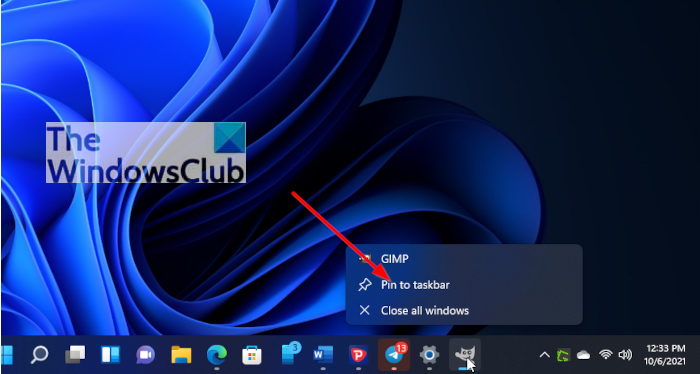
When you open an app, its icon appears on the taskbar with a line underneath, indicating it’s active. For those who want to pin the app, simply right-click on the icon, then select Pin to taskbar, and that’s it.
Pin an app that is not running:
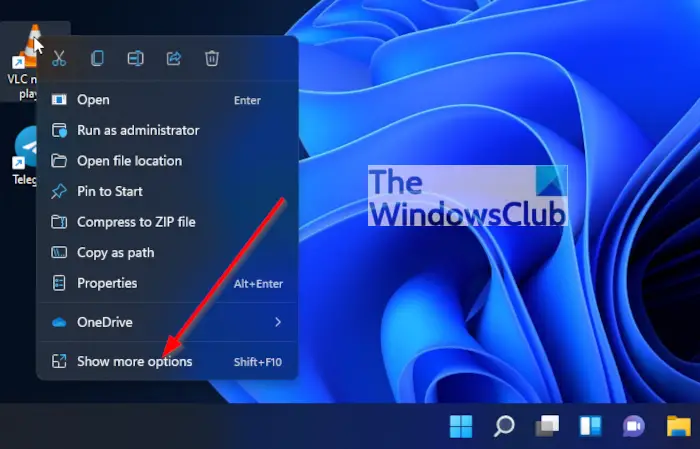
In a situation where the app is not running, but the icon is located on the Desktop, all you have to do is right-click on the icon then select Show more options. From the context menu, click on Pin to taskbar to have it appear on the new Windows 11 taskbar.
Pin apps from the Start Menu:
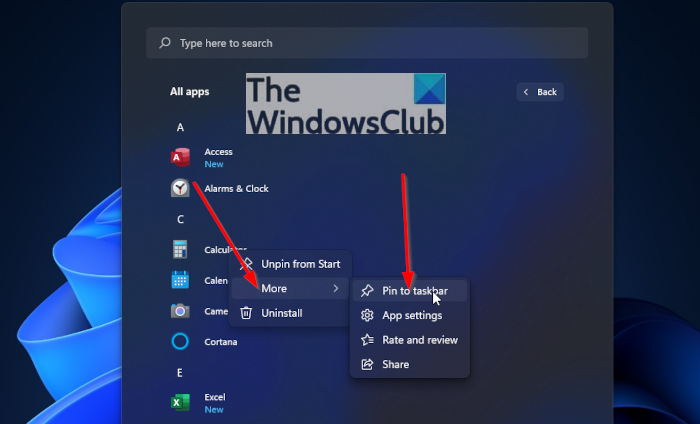
- Now, in terms of apps located in the Start Menu, please press the Windows key on your keyboard or click the Start button on the taskbar.
- From there, select All Apps, then find the app you want to pin.
- Finally, right-click on the app and select More > Pin to taskbar.
Read: How to increase Taskbar to 2 or more rows in Windows 11
2] Remove pinned apps and icons from the Windows 11 taskbar
After adding several apps, you may need to keep the numbers down by deleting apps from the taskbar. This is a simple task, so let us discuss how to get it done effectively.
Unpin apps via the taskbar:

- To do this, you must right-click on the icon
- Then select Unpin from taskbar.
- Right away, the icon should disappear until you want it back there again.
You can also make Windows 11 Taskbar look like Mac Dock.
Unpin apps via the taskbar Settings area:
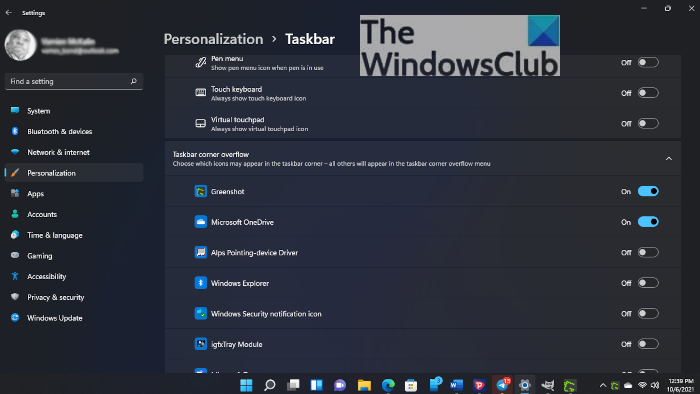
- Another way you can remove apps is to find your way to the taskbar settings.
- Do this by pressing the Windows key + I to fire up the Settings menu
- Or click on the Start Menu button, then select Settings from pinned apps section.
- After that, go to Personalization > Taskbar
- Then use the toggle button to disable apps and icons from the Windows 11 taskbar.
3] Move the taskbar icons to the left from the center
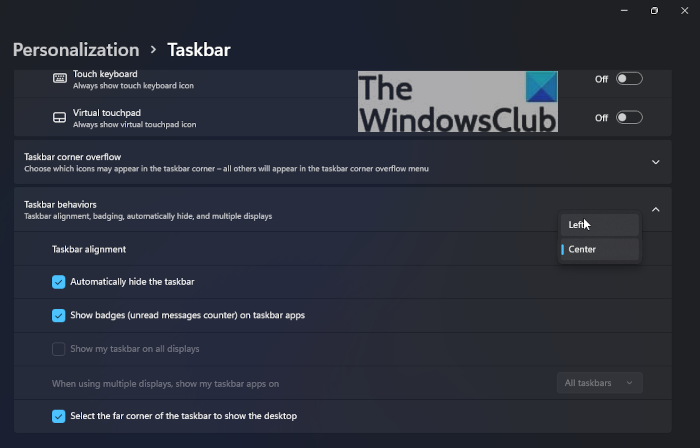
Most of us are used to the taskbar where the icons are located to the left, where the Start Menu button is situated in the bottom-right corner. You can return to that design if you wish, and we suspect many Windows 11 users will make the switch right out of the gate.
- Do this by right-clicking on the taskbar, then select Taskbar Settings.
- A new window will appear instantly with several options to choose from.
- Please scroll down to Taskbar Behavior, then change it from Center to Left.
Additionally, you should see the option to automatically hide the taskbar, show badges on apps, and the ability to hide the far corner button to the right that is designed to show the Desktop.
TIP: You can also set up a Vertical Taskbar in Windows 11.
4] How to Show or Hide Taskbar corner icons in Windows 11?
Taskbar corner icons are those system icons that appear in the notification are on the tight side of the taskbar.
- From the Taskbar Settings area
- Navigate to Taskbar corner icons to add or remove Pen Menu, Touch Keyboard, or Virtual Touchpad.
5] Change Taskbar position in Windows 11
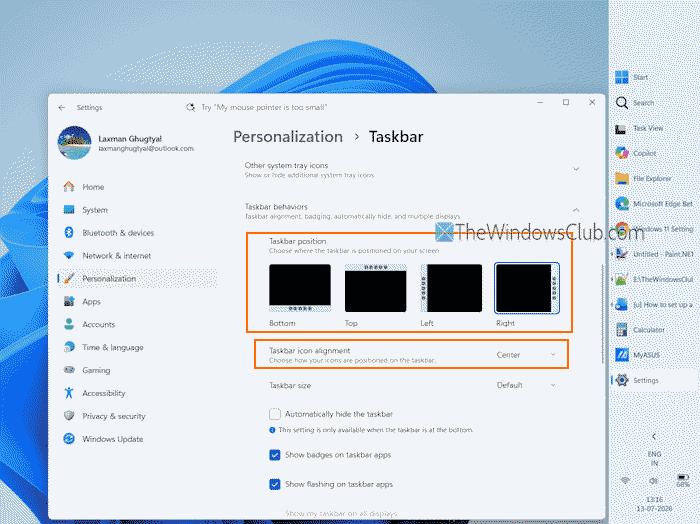
Starting with Windows 11 build 26300.8493 (version 25H2) and higher, you can change the Taskbar position to Top, Bottom (default), Left, and Right. Here are the steps:
- Press the Win+I shortcut key to open the Windows 11 Settings app
- Navigate to Personalization > Taskbar
- Expand the Taskbar behaviors section
- Select a Taskbar position. For example, to set a vertical Taskbar in Windows 11, select Left or Right.
6] Change Taskbar size in Windows 11
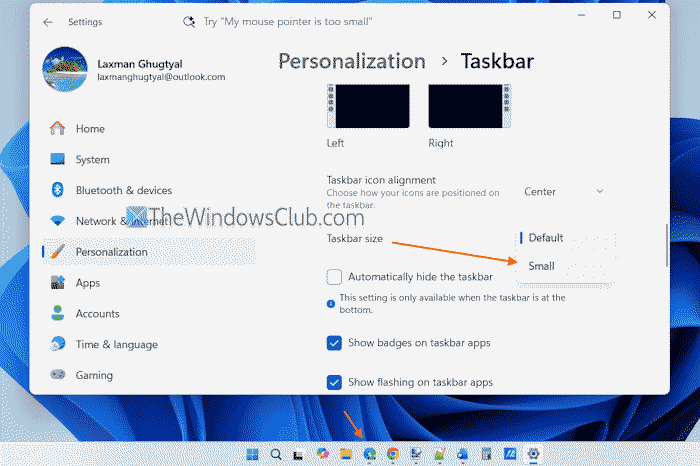
Windows 11 also lets you change the Taskbar size from Default to Small. In Settings, go to Taskbar and expand Taskbar behaviors. Use the Taskbar size drop-down menu to switch between Default and Small.
7] Show or hide Taskbar buttons
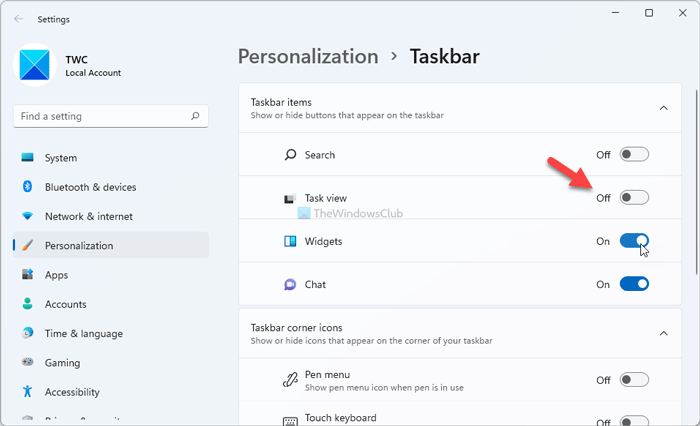
Here are the steps to show or hide Taskbar buttons in Windows 11:
- Use the Win+I hotkey to open the Settings app
- Go to Personalization > Taskbar
- Expand the Taskbar items option
- Use the toggle to show or hide Widgets, Resume, and Task view buttons on the Taskbar. For the Search button, you have the options to hide it, show only the Search icon, or show the Search icon and label.
8] Show or hide additional system tray icons
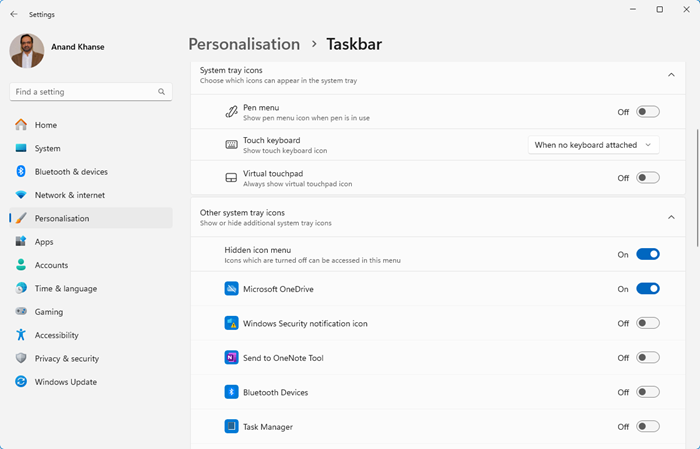
The steps to show or hide additional system tray icons in the Windows 11 Taskbar are as follows:
- Open the Settings app (Win+I)
- Select Personalization > Taskbar
- Expand the Other system tray icons option
- Use the toggles to show or hide various system tray icons such as Task Manager, Microsoft OneDrive, Screen Reader, Microsoft Outlook, Bluetooth Devices, Copilot, Windows Update Status, etc.
9] Show or hide time and date in the Taskbar system tray
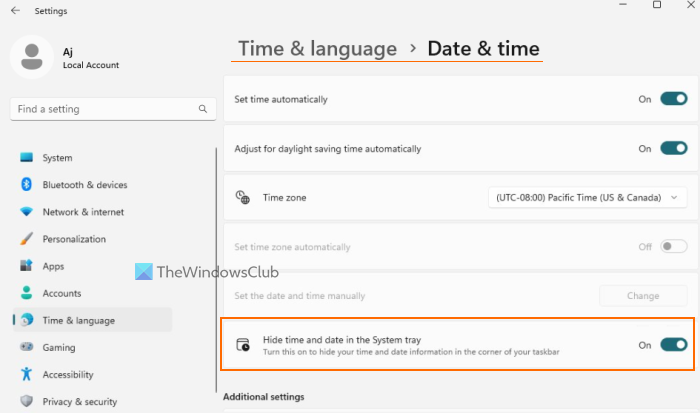
To show or hide time and date in the Taskbar system tray, right-click on the clock and select Adjust date and time. This will open the Date & time settings page. Use the Show time and date in the System tray toggle to turn it on/off. You can also expand this option and set additional clocks and show seconds in the system tray clock.
10] Auto-hide the Taskbar in Windows 11
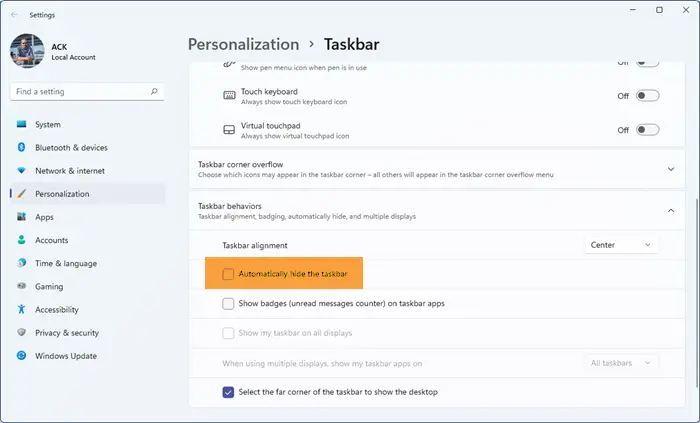
You can also enable the Automatically hide the taskbar option in the Settings app of Windows 11. This works in desktop mode and tablet mode. However, you can use this setting only when the taskbar position is set to Bottom.
11] Prevent changing Taskbar size in Windows 11
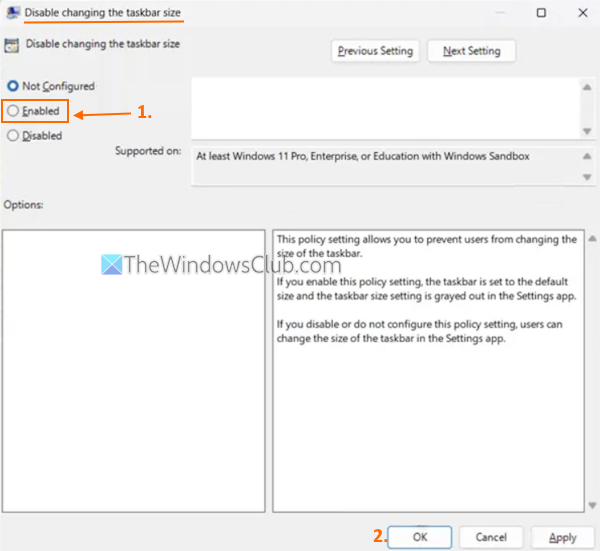
There’s a Group Policy setting that can be used to prevent changing the Taskbar size in Windows 11. Once configured, the Taskbar size option in the Settings app will be greyed out. Here are the steps:
- Type gpedit.msc in the Search box and hit Enter to open the Local Group Policy Editor window
- Access the Start Menu and Taskbar folder. The path is:
Computer Configuration > Administrative Templates > Start Menu and Taskbar
- Open Disable changing the taskbar size setting by double-clicking on it
- Select Enabled
- Press OK.
To undo the changes, set Disable changing the taskbar size setting to Not Configured.
Alternatively, you can create a DWORD (32-Bit) Value in the Registry Editor window. Rename it to DisableTaskbarSize and set its Value data to 1 (as visible in the image below) to disable changing the Taskbar size. The location to create this value is:
HKEY_CURRENT_USER\Software\Policies\Microsoft\Windows\Explorer
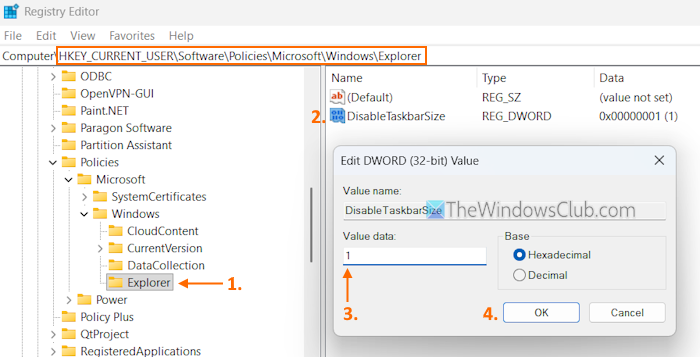
To undo the changes, you can delete the DisableTaskbarSize value.
12] Prevent changing Taskbar position in Windows 11
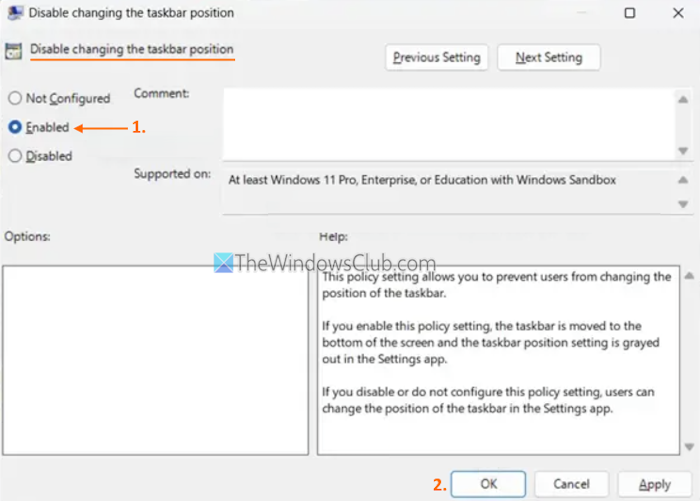
You can also use a Group Policy setting to prevent changing the Taskbar position in Windows 11. Once applied, the Settings app options to change the Taskbar position will be greyed out. Here are the steps:
- Open the Group Policy Editor window
- Navigate to the following path:
Computer Configuration > Administrative Templates > Start Menu and Taskbar
- Double-click on the Disable changing the taskbar position setting
- Select the Enabled option
- Press the OK button.
You can also use a Registry trick for the same. Create a DisableTaskbarPosition DWORD (32-Bit) Value in the following location:
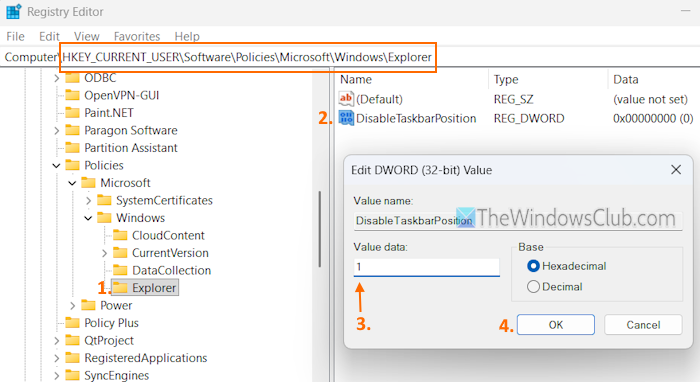
Set its Value data to 1 and press OK to disable changing the Taskbar position using the Registry Editor.
To undo the changes, you can delete the DisableTaskbarPosition value.
That’s all.
How do I get the classic Taskbar back on Windows 11?
To restore the classic Taskbar in Windows 11, use the open-source ExplorerPatcher app. This app requires you to tweak a few settings. For example, you can set the Taskbar style to Windows 10 and choose Bottom as the Primary taskbar location.
How do I customize the Taskbar corner in Windows 11?
To customize the Taskbar corner in Windows 11, open Taskbar settings in the Windows Settings panel. Next, expand the System tray icons and Other system tray icons sections one after the other and change the settings as per your requirements. Once done, you can find a fully customized Taskbar corner.
Now read: How to customize the Windows 11 Start Menu.
