
If you are a gamer or a graphics artist, the graphics card is the first thing you will check on a Windows 11/10 laptop. So gamers and video/graphics artists know where to look for the Graphics Card on a PC, but if you are a regular PC user trying to find out how to check your graphics card, this post is for you.

As a regular PC user, I had no clue about graphics cards; in fact, I couldn’t answer if someone asked me what graphics card my laptop has. So, here is what I did to find out the exact name and brand of the graphics card and its driver on my PC.
Which Graphics Card do I have on my PC
There are quite a few ways to find that; I am listing all those ways here. You can use whichever seems convenient to you.
- Using the DirectX Diagnostic Tool
- Using Task Manager
- Using the Display Settings
- Using Device Manager
- Using freeware.
Let us take a look at these methods in detail.
1] DirectX Diagnostic Tool
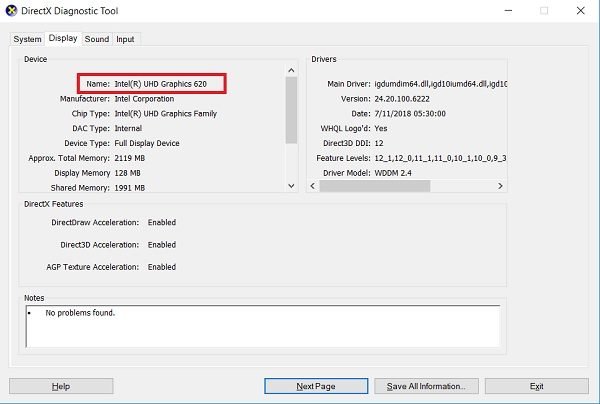
You can get all the details information about your graphics card and the driver through the DirectX Diagnostic Tool.
- Open Run by pressing Win+R, type dxdiag, and press ENTER.
- This will open a new window which shows detailed information about your system.
- Under the Display tab, you will find your graphics card details.
- You can check the exact name and brand of your graphics card, the driver, its version, date, and much more.
2] Task Manager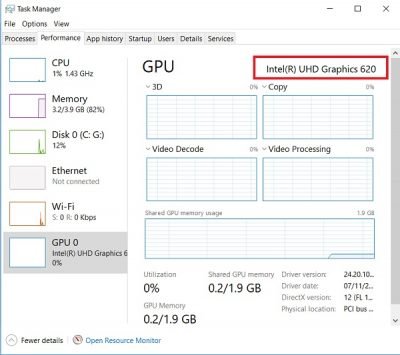
Yes, you can also check your graphics card in Task Manager. Press Win+X and select Task Manager. Alternatively, you can open it by pressing CTRL+Shift+ESC.
Go to the Performance tab and under the GPU tab; you can check your graphics card, its driver, the version, and the performance details too.
Read: DDR3 vs DDR4 vs DDR5 Graphics Card.
3] Display Settings
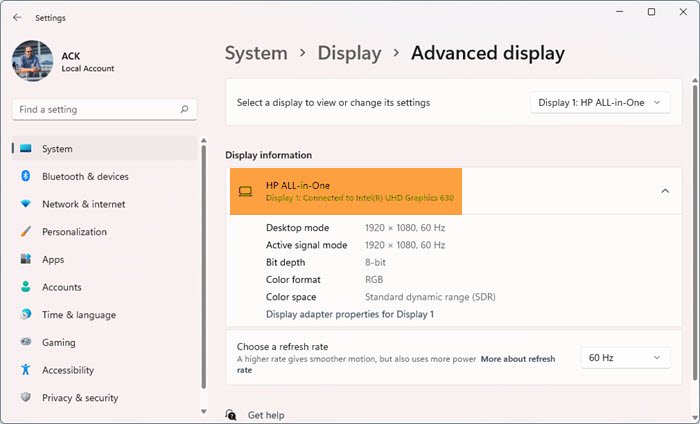
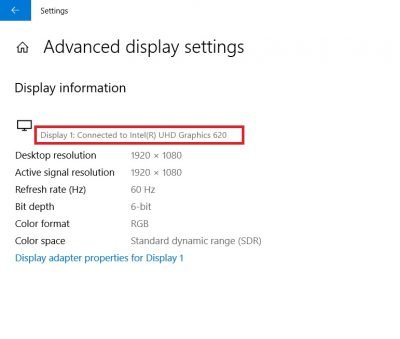
On the Desktop, right-click and go to the Display Settings. Scroll down and select ‘Advanced Display Settings’. There you will find the graphics card installed on your PC.
Your graphics card may also have its own control panel, and you can reach there by right-clicking on your desktop. 
Right-click on your desktop and click on the graphics card name and you can check its properties in detail. Click Options and Support to view details like physical memory, processor and speed, OS version and more.
4] Device Manager
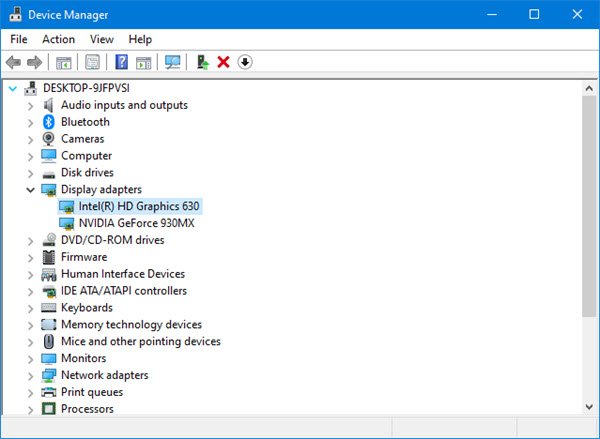
From the WinX Menu, open Device Manager. Expand Display adapters, and you will see the Graphics Card details mentioned.
In the above image, you see two entries:
- Intel(R) HD Graphics 630
- NVIDIA GeForce 930MX.
This means that the Intel one is the integrated graphics card and the NVIDIA one is the dedicated graphics card. If only one is mentioned, it means you have only 1, i.e., the integrated graphics card.
Right-click it and select Properties to see more details.
Read: Integrated or Dedicated Graphics card – Which do I need?
5] Using freeware
You can also use third-party software or tools to view your system’s hardware information. Some of the free software to view your system’s hardware information on Windows 11/10 are given below:
- CPU-Z
- Speccy
1] CPU-Z
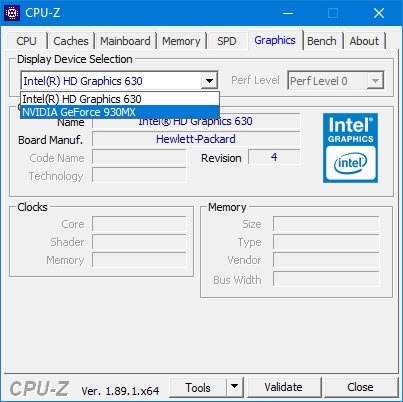
If you are looking for a freeware to do the job for you, you can download CPU-Z. This tool gathers information about your system’s main devices. It will not only give you information about your Graphics card but also other important system information. Go to the Graphics tab. If you see one entry, it means that you have only the integrated graphics card installed. In the image above, you can see that a dedicated NVIDIA card is also installed.
2] Speccy
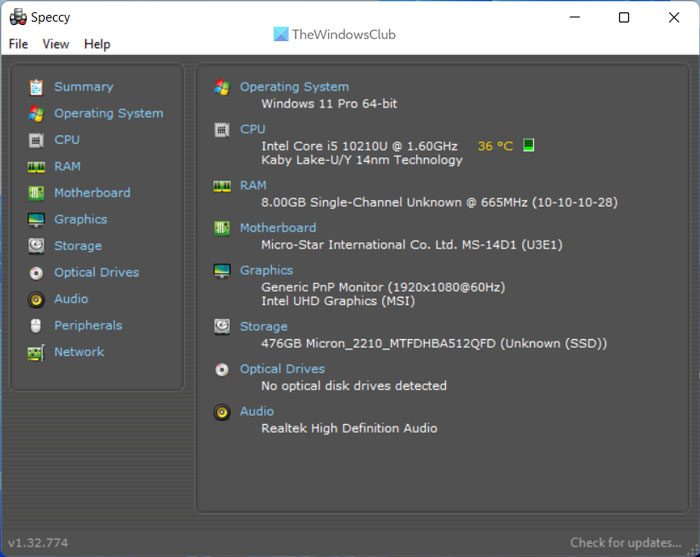
Speccy is a free software that lets you view your system’s hardware information. When you launch it, it analyzes your system’s hardware and displays the information of different hardware components. You can view the overview of your hardware components on the Summary page of the software. If you want to view detailed information of a particular hardware component, select it from the left pane.
In the File menu, you will find the options to save your computer’s hardware information as an XML and a text file. Apart from that, the Print option is also available in the File menu.
These were a few ways to check what graphics card your PC has.
How do I check my graphics card on Windows 11?
You can check which graphics card is installed on your Windows 11 computer by opening Device Manager. Open Device Manager and expand the Display Adapters node. There, you will see all the graphics card drivers. This lets you see which graphics card brand is installed on your PC. This article explains a few ways to check which graphics card is installed on your system.
Will more RAM improve Intel HD Graphics?
Adding more RAM to your system will improve overall performance. More RAM will also give you a better FPS in your video games. But graphics quality depends on your graphics card. So, if you want better graphics quality, you need to upgrade your graphics card.
This post will show you how to find out Computer RAM, Graphics Card, Video memory & other hardware specs of your PC.
