
Windows 11/10 has an incredible feature that lets users create a Wi-Fi history, making it easier to access their regular Wi-Fi connections. It’s a built-in feature that lets you create a history of network activity, including network names, session durations, timestamps, etc. With this feature, you will also need to track usage details, including which devices were used, how many times they were used, and where they were connected.
Windows 11/10 provides details about its hardware and software capabilities and also helps manage the system’s wireless connections. The Wi-Fi Network Adapter Report is one of the Windows 11/10 operating system features that provide step-by-step detailed information about the functioning of the wireless device connected to the computer. One of the most common wireless networks used in our systems is Wi-Fi, today we will elaborate on the process of creating a Wi-Fi network adapter report on Windows 11/10.
A network adapter report is useful for troubleshooting by identifying errors, measuring session durations, and displaying output from commands entered at the command prompt. The report also provides details regarding network adapters used for wireless processing by the computer system. In this article, we will show how to generate a Wi-Fi network adapter report in Windows 10. So, moving on to the next section, let’s take a look at it.
Create a WLAN Report or Wi-Fi Network Adapter Report in Windows 11/10
Network adapter reports are commonly used for correcting errors in internet connectivity. It helps the user identify the errors that caused the adapter to be unable to send a command to connect to the internet. The error may also occur due to wrong input in the command prompt window, which may corrupt the function adapter. In this scenario, you may want to troubleshoot the wireless network issue to an access point.
To create a WiFi History Report in Windows 11/0, you need to run a command-line tool. This tool will then save the report as an HTML file on your PC. The HTML will consist of the connectivity history for the last three days. For that, you will need, the name of the network with which the PC was connected, the time when the session in question began, the time when it ended, the duration of the session, and any record of errors that might have occurred. The main feature of this report is the WiFi summary chart, which shows the WiFi connection session, though it isn’t limited to the same. The report provides nearly all the details you need to analyze your system’s network performance.
Follow these steps to create a Wi-Fi network adapter or WLAN Report with detailed information:
- Open an elevated Command Prompt.
- Type the following –
netsh wlan show wlanreport - Press Enter to create a Wireless adapter report.
- Now, visit the \WlanReport\ folder
- Open the wlan-report-latest.html file.
That’s it. However, if you want to learn the above steps in detail, here they are.
You can access the Network adapter reports by running a simple command in the Command Prompt on the computer. Therefore, you first need to open an elevated Command Prompt and run the associated command line. Let’s take a look at the detailed descriptions of the processes involved in the methods above!
To get it started, press the Windows+R keyboard shortcut to open the Run dialog box, you can also open it using the WinX menu. Once it opens, type cmd in the input field and press Ctrl+Shift+Enter keys to run the command prompt with admin privileges.
If User Account Control (UAC) prompts on the screen and asks for your permission then click on the Yes button to continue.
Once the command prompt window appears on your screen, type the below command and press Enter to create a wireless adapter report:
netsh wlan show wlanreport
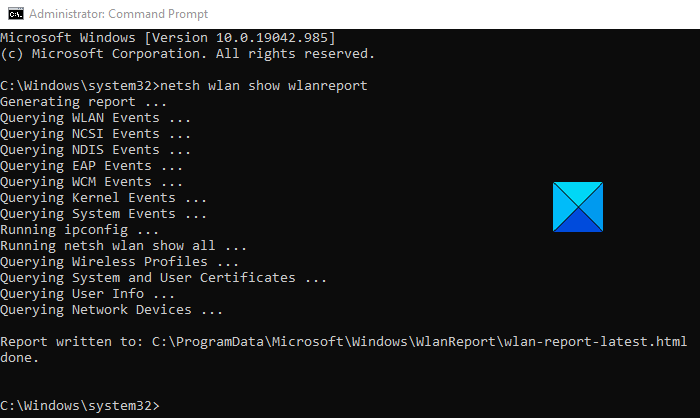
Now, to view the created wireless adapter report, type the command below and again hit Enter:
C:\ProgramData\Microsoft\Windows\WlanReport\wlan-report-latest.html
The ProgramData folder is hidden, and to access it, click the ‘View’ tab and tick the checkbox for “Hidden items”.
Clicking the HTML report file opens it in your browser.
Once the action is complete, the report will open in the default web browser, displaying details such as connection status, connection time, any errors, network adapter details, and session success & failure status. It will include a detailed report and a graph to help the user cover all aspects of Wi-Fi operation. Thus, you can create a Wi-Fi network adapter report on your Windows device.
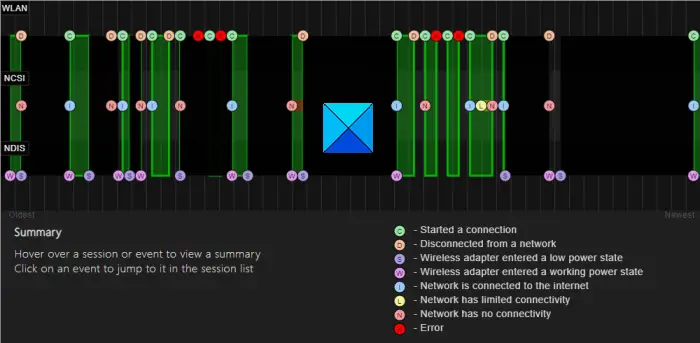
You can now view the connectivity details for your Wi-Fi usage. The red circle indicates an error. Selecting it provides more information about the error. It is an interactive report and moving the mouse cursor will give you more information about the item.
The main feature of this report is the Wi-Fi summary chart, which shows Wi-Fi connection sessions. Additionally, you can view user information, network adapter details, Script Outputs, Session Durations, Wireless Sessions, and more.
TIP: If netsh wlan show wlan report fails with an error 0x3A98, 0x2 or 0x5, you could try and refresh your Modem and see if that helps.
Related:
- How to view Wi-Fi Network Adapter settings
- Improve Wireless Connection Latency with WLAN Optimizer.
- How to view Wi-Fi Network Profiles stored
- How to view Wi-Fi Network Driver information.
