
A normal WiFi network should be able to cover your entire home or office so you can use it from anywhere and on any device, such as a laptop or phone. How often do you get to use the optimal signal strength of your wireless network? This could be due to various factors I’ve listed below. This article offers guidance on extending the range of WiFi signals.
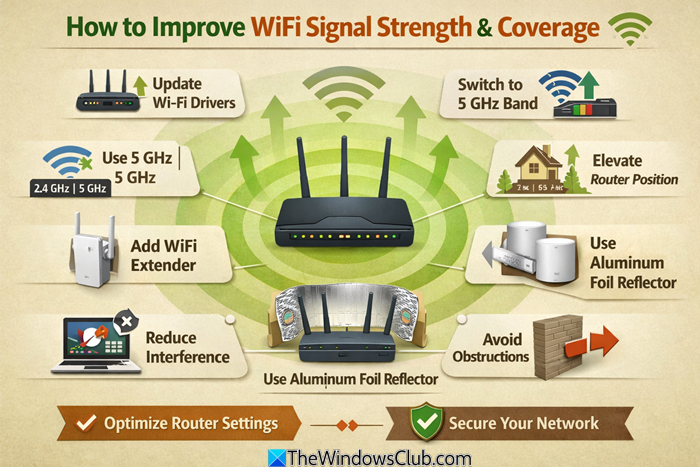
How to increase WiFi Signal strength and Coverage area
Follow these steps to improve, boost, extend, or increase the Wi-Fi router signal and range at home or the workplace, without spending a dime. However, before you begin, it’s a good idea to check your internet connection speed.
- Extend WiFi Signal Area with Better Placement of Router
- Adjust Obstacles for Flow of Signal Strength
- Put an Aluminium foil behind the router
- Remove Other Wireless Devices
- Omnidirectional vs. Unidirectional Antennas
- Use Repeaters To Increase WiFi Range
- Upgrade Network Cards and Router.
1] Extend WiFi Signal Area with Better Placement of Router
One of the most important considerations when designing a wireless network is where to place the router. You would want all corners of your house or office covered so that people can use it from anywhere. For that, you need to find the optimal location for the router. To do this, draw a rough layout of your house on paper. See where and how many walls and other obstructions are present.
If your router is placed in an inside room and you want to use it outside on the porch, you may not get the wireless signal, as the waves are blocked by all those walls and furniture, etc., between the router and your porch.
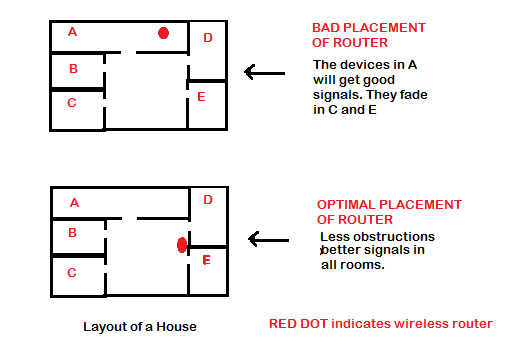
Refer to the image above for a clearer understanding. The red dot represents the router, and all rooms are designated by letters. You can see how the walls and placement create a problem. The layout also shows how to select an optimal router position: one that is almost equidistant from all your rooms and other areas you wish to cover with WiFi. Consider the entire coverage area you want and determine the central position that allows proper signal flow in all directions, thereby extending the WiFi network range.
Read: Things in your home that can block or obstruct Wi-Fi signal
2] Adjust Obstacles for Flow of Signal Strength
Apart from the wall, items such as your cupboards, water coolers, and mirrors can weaken and even kill the WiFi signals moving in that direction. Almirahs are mostly made of metal, which may prevent signals from crossing over through the unit. Water dampens the 2.4GHz signal for some reason. This is the usual frequency used by wireless routers and even other wireless devices in your home. Mirrors have a special coating on the back that absorbs signals of the specified frequency (2.4 GHz).
Just check whether they can be moved from the invisible straight line between your router and the place you wish to use a WiFi device. If so, you can adjust the items to make it easier for wireless signals to pass through. Breaking down walls will further ease signal flow, but I wouldn’t suggest doing so to increase the signal range! Instead, we’ll discuss repeaters to compensate for signal strength loss when signals travel through walls.
Read: Improve Wireless Connection Latency with WLAN Optimizer.
3] Put an Aluminium foil behind the router
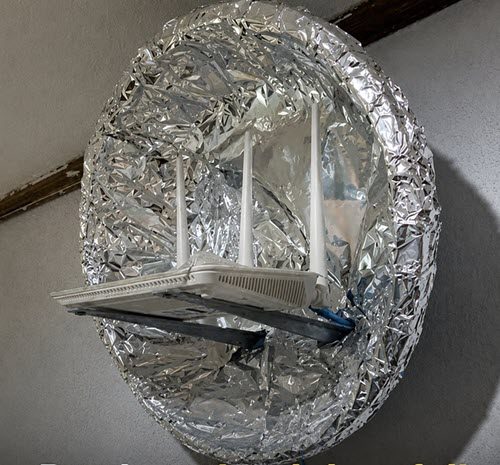
Using aluminum foil behind your router can help redirect or focus Wi‑Fi signals. The foil may reflect signals toward one direction while weakening coverage elsewhere, causing inconsistent performance. But you can try this and see if it helps in your case.
4] Remove Other Wireless Devices
As mentioned earlier, WiFi signals travel at 2.4 GHz. I do not know exactly how, but some routers do offer the option to switch to 5GHz. If you can do that (check your router settings in a browser), nothing beats it. But if there is no option in the router, try to minimize wireless devices around the router and the wireless device you are using on WiFi. Almost all household appliances, including wireless mice, printers, and even microwave ovens, operate at 2.4 GHz. Since you need these devices and cannot get rid of them, make sure there is minimal interference among all these smart appliances.
TIP: This post will help you if you face slow Internet speed on Windows 11.
5] Omnidirectional vs. Unidirectional Antennas
In the first layout shown in the image above, if the antenna is omnidirectional, it wastes half of your WiFi signal by sending it out of the house. In such cases, go for unidirectional antennas. You can combine unidirectional antennas with repeaters to improve WiFi signal strength in rooms on the opposite side of the unidirectional antennas’ direction.
Read: Is WiFi safe for your health?
6] Use Repeaters To Increase WiFi Range
Some people place the repeaters just at the point where the original wave frequency is very low. That setup, though fine, will not provide you with strong enough signals. Keep the repeaters in the zone where signal strength is still relatively strong. That way, you can boost WiFi signals to extend its range.
Must read: How to increase WiFi Speed in Windows 11
7] Upgrade Network Cards and Router
WiFi works fine when the router and network cards are of the same type. Routers and network cards are relatively inexpensive. Many companies are selling them under $100, while network cards are somewhere between $30 and $50 (as published on the CISCO site). If you are willing to spend money, consider upgrading to a better network and see how it improves your WiFi coverage.
Hope the post helps you.
TIP: Check this post if your Windows PC suffers from poor WiFi performance. You can also change WiFi Roaming Sensitivity or Aggressiveness to improve Wi-Fi reception & performance.
Let me know if I missed anything.
