
Wanting to write a research paper, but don’t actually know where to start? It can be daunting, however, what if there were an assistant to help find relevant resources, summarise complex studies, and so on? The good news is that these assistants now exist in the form of AI tools. In this guide, we will walk through the best AI tools available today to make writing a research paper easier.
Best AI tools for Research Paper Writing
If you are looking for AI tools that can assist you in writing research papers, take a look at the list we have curated below.
- Consensus
- Stanford’s Storm
- Elicit
- Scite
- Semantic Scholar
- ChatPDF
- Humata
- NotebookLM
- Grammarly
- Wordtune
Let’s get this guide started.
1] Consensus

If you were looking for a tool that allows you to ask a direct question and give a science-based answer, Consensus is for you. It is like a specialised search engine that reads through peer-reviewed journal articles and gives a summary of what the research actually says. What makes this stand out from others is its Consensus meter, which provides statistics of researchers agreeing or disagreeing with the claim. To get started with it, go to Consensus.app.
2] Stanford’s STORM
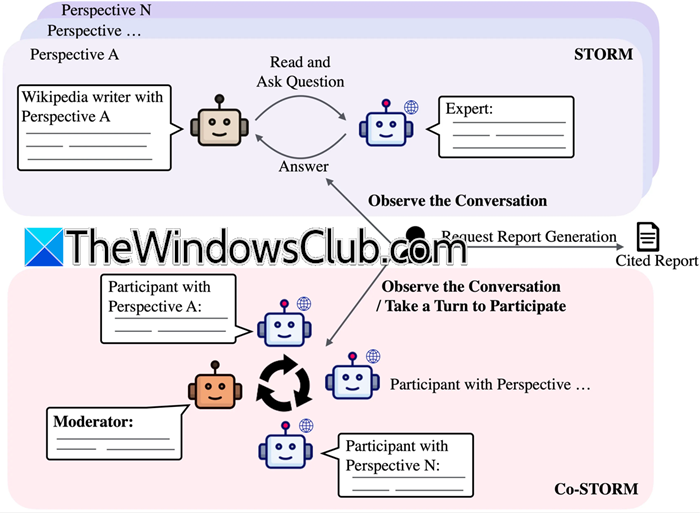
STORM (Synthesis of Topic Outlines through Retrieval and Multi-Perspective Question Asking) is an experimental AI system from Stanford University. As the name suggests, it focuses on creating a detailed and structured outline for Literature reviews. It’s a tool that generates different viewpoints and acts as a moderator for a debate about the topic by having participants cross-examine each other, thereby creating a discourse about the topic. By examining this conversation, users can identify themes, research gaps, and debates before starting their paper.
This is an exciting research project from Stanford University designed to generate Wikipedia-style articles from scratch. However, it is characterised as an experimental system. While a public demo website exists, which you can access from storm.genie.stanford.edu, it may not be a stable, commercially available product in the same way as the others on this list
3] Elicit
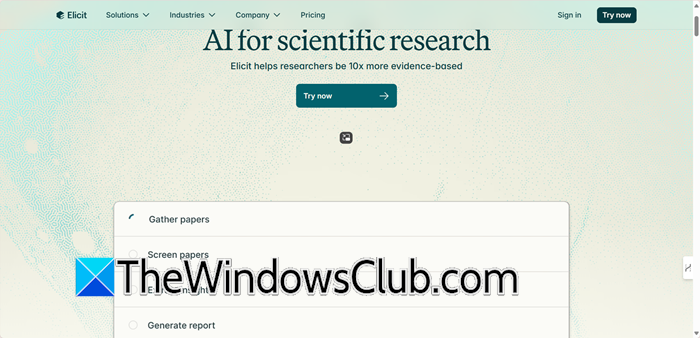
If you are looking for a super-organised research assistant, Elicit.com fits the role. It not only gives relevant papers but also extracts specific details from the uploaded PDFS into customizable tables. It makes articulating information across dozens of papers quite easy, as it allows users to compare methodologies, results, and participant count simultaneously. Elicit is quite useful, particularly for last-minute legends who need to synthesize a large body of work and require results as soon as possible.
4] Scite
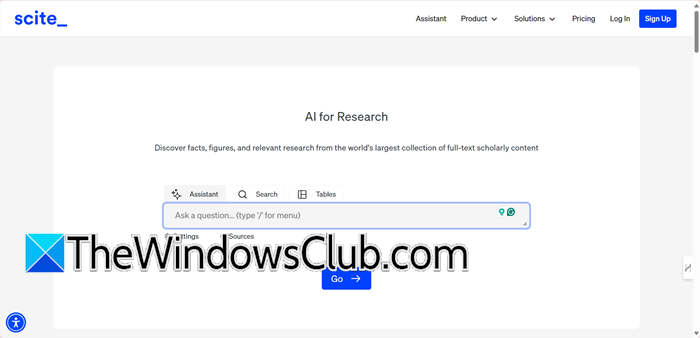
For everyone fed up with mystery citations from ChatGPT, Scite.ai is the lifesaver. It not only lists citations but also provides a background story behind them. With the help of AI, each citation is classified as supporting, contrasting, or merely mentioning the original work. These smart citations help researchers build a nuanced argument about the current stage of knowledge in their fields and add credibility to their Literature review.
5] Semantic Scholar
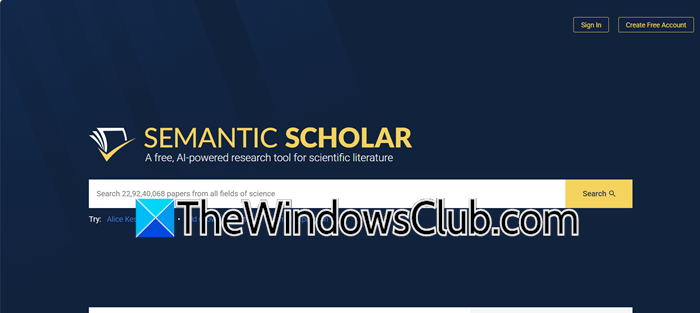
Ever used Google Scholar? Well, Semantic Scholar, developed by the Allen Institute for AI, is the smarter, more intuitive version of it. It uses AI to generate plain-English summaries (TL;DR) of complex research papers. The tool also highlights the most important citations and key findings, as well as keeps users updated on new relevant research. It’s a fantastic free tool to keep in tune with the field without getting overwhelmed with new information. You can go to semanticscholar.org and start using it.
6] ChatPDF
We have all faced that daunting 40-page PDF, but ChatPDF.com is here to save the day. It is an interactive document reader that allows users to upload any PDF, and the tool will create a conversational interface around it. They can ask specific questions about content, such as requesting definitions, clarifying methodologies, or summarizing sections without going through the whole PDF. This makes the reading process more targeted as it quickly extracts information from books, PDFs, and theses.
7] Humata
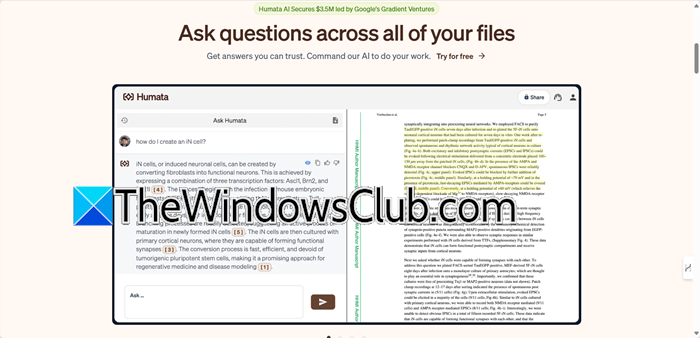
Humata.ai is designed to analyse technical and research documents on a large scale. If ChatPDF interacts with a single document, Humata communicates with the entire research folder simultaneously. It compares information across different PDFs, generates detailed reports, and synthesizes findings from the entire collection of research papers. This makes it ideal for projects that require merging information from a large volume of source material.
8] NotebookLM
NotebookLM from Google takes a unique approach from other tools. Here, users create a notebook where they provide the AI with their own sourced document. The AI then form all its responses on this provided material. It’s like having a research partner who has only read what we have given them, and this is useful since it reduces the risk of invented facts.
Read: What are the best AI Tools for Legal Research?
9] Grammarly
Grammarly.com is the hub where researchers can visit to polish their papers. It is a comprehensive writing tool that goes far beyond checking and correcting grammatical errors. Its AI analyses tone, clarity, coherence, and punctuation. The premium version offers genre-specific writing style suggestions and, therefore, is an effective tool when it comes to dealing with the formal tone needed in academia. Moreover, it provides real-time feedback and integrates seamlessly into word processors and browsers.
10] Wordtune
Wordtune is another option which acts as a real-time editorial assistant, ready to step in when a sentence just doesn’t sound right. As users write, it offers different ways to rephrase text and make it more formal, clear, and concise. It is less about correctness and more about ensuring fluency of the text so that the content is more refined and polished. Access Wordtune from their official website, Wordtune.com.
That’s it!
Read: How to use Perplexity AI for Deep Research
Can AI write a whole research paper for free?
The straightforward answer to this question is, yes, it can. However, the practical answer is no. It can generate text and assist with various sections; however, it lacks a deep understanding and often invents facts and produces unoriginal work. They are best used as a powerful assistant for tasks like summarising and editing, but not as authors.
Read: How to use You.com AI for productivity and research
Is ChatGPT 4 worth it for academic writing?
Yes, if used strategically. ChatGPT-4 is a powerful assistant for brainstorming, outlining, and drafting less critical sections. However, it’s best to accelerate the workflow, rather than replacing one’s own critical analysis and writing.
Read: Unriddle AI review: Read research papers faster with Unriddle AI
