
If you are in a field that requires legal research, we have a perfect companion for you. There are various AI tools for legal research that you can use to fetch content related to law, legislation, and jurisdictions. With the help of ML and NL processing, they break down large datasets to give you specific results in a very short amount of time. In this post, we are going to talk about some of the best AI tools for legal research.
Best AI Tools for Legal Research
If you are looking for some of the best AI tools for legal research, go through the list given below.
- Harvey AI
- CoCounsel (Thomson Recruiter)
- Eudia
- Everlaw
- ChatGPT
- Sandstone
- Legora
- Mike Open Source.
Let us talk about them in detail.
1] Harvey AI

First of all, let us talk about Harvey.AI. It is built on OpenAI’s GPT architecture and fine-tuned for legal workflows, making it perfect for complex research, contract analysis, and litigation strategy. Its agentic AI autonomously executes multi-step research tasks. One of its key capabilities is conducting thorough, source-based legal analysis in minutes, mimicking human researchers’ workflows. It can also analyze law across 53+ countries and languages. It has an enormous knowledge vault, allowing it to securely process firm-specific documents to generate tailored insights.
Harvey AI is enterprise-grade security with zero data retention and is hosted on Microsoft’s Azure Cloud platform. You can visit harvey.ai to know more about this.
2] CoCounsel (Thomson Reuters)

CoCounsel is integrated with Thomson Reuters’ Westlaw and Practical Law databases, making it ideal for case law research, contract review, and litigation strategy. Its AI leverages Thomson Reuters’ authoritative legal content to deliver precise, real-time analysis. One of its key capabilities is its Authority Validation system, which automatically embeds hyperlinks and KeyCite flags to verify case validity and pinpoint critical precedents. It also deploys a Deep Research Agent that autonomously executes multi-step research workflows, generating memos with citations from verified sources like court opinions and statutes. Additionally, it identifies risks in legal documents by flagging hallucinated cases or mischaracterized laws.
CoCounsel operates with enterprise-grade security, featuring zero data retention and encryption compliant with U.S. federal court standards. Hosted on Thomson Reuters’ secure cloud infrastructure, it is trusted by 20,000+ legal teams. You can visit thomsonreuters.com to learn more.
3] Eudia
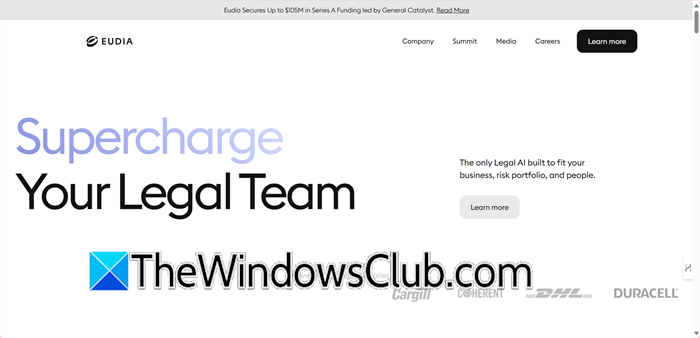
Eudia.com is a platform that combines advanced AI technology with human legal knowledge. It helps businesses manage risks, optimize contracts, and align their strategies. The AI can independently handle data-heavy tasks while ensuring that humans oversee ethical and creative decisions. One important feature of Eudia is its ability to create risk heatmaps. These maps show legal risks across contracts, helping businesses identify and address issues before they become problems. The platform also automates tasks like compliance checks and due diligence, turning legal work into useful business insights.
Additionally, Eudia has a knowledge retention system that helps retain important information when employees leave. If you are interested, visit their official website, eudia.com.
4] Everlaw
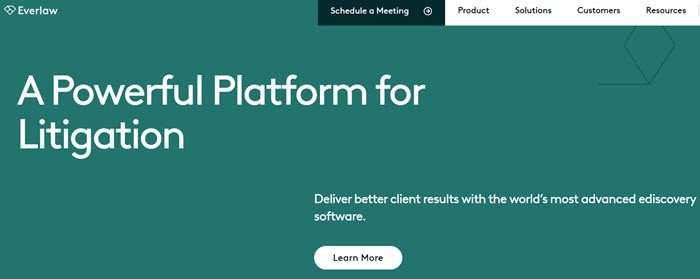
Everlaw.com is built on a cloud-native architecture and optimized for eDiscovery challenges, making it ideal for litigation preparation, internal investigations, and complex document review. Its AI-powered platform autonomously processes, analyzes, and visualizes large-scale legal data. One of its key capabilities is Deep Dive, a generative AI tool that answers natural-language queries with citations to supporting evidence, allowing attorneys to uncover case-critical facts in seconds rather than days.
It also processes 900K documents per hour with real-time analytics, supports 135+ languages for multilingual document translation, and generates interactive visualizations to reveal hidden relationships in data. Additionally, its Storybuilder feature enables collaborative case-building by organizing evidence into chronological narratives for depositions or trials. You can visit everlaw.com to learn more about it.
5] ChatGPT
ChatGPT.com leverages OpenAI’s GPT-4 architecture and can be augmented with plugins or custom GPTs for legal tasks, making it useful for preliminary research, drafting memos, or simplifying complex concepts. When integrated with legal plugins, it accesses real-time databases to ground responses in authority.
ChatGPT enhances legal research through three key workflows enabled by specialized plugins.
- Plugin-Powered Research: The Thomson Reuters integration allows natural-language queries, such as “Find recent New York appellate cases about noncompete clauses in tech employment contracts,” pulling information directly from Westlaw and Practical Law with hyperlinked citations and validity alerts.
- Document Review: Using the Code Interpreter, ChatGPT analyzes uploaded contracts (PDF/Word) to identify critical clauses and flag inconsistencies against a firm’s compliance standards, speeding up due diligence.
- Drafting Assistance: ChatGPT generates jurisdiction-specific templates for deposition outlines, demand letters, and research memos, ensuring compliance with local rules.
These workflows make ChatGPT a valuable preliminary tool for legal tasks, but its outputs should be cross-verified with dedicated legal AI tools like Harvey or CoCounsel for authoritative checks.
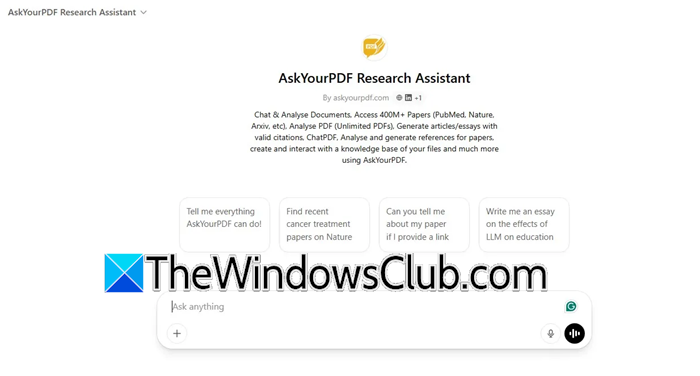
Some of the plugins that you can use are AskYourPDF Research Assistant, AI Lawyer, and LegalChat.
6] Sandstone
Sandstone AI is a legal-tech startup that builds specialized AI tools for in-house legal teams, helping small and mid-sized companies streamline workflows, automate document tasks, and manage legal relationships more effectively. Unlike competitors targeting law firms, Sandstone.com is designed for corporate legal departments.
7] Legora
Legora AI is a leading legal-tech platform designed for law firms and corporate legal teams, combining AI speed with expert judgment. Legora.com helps in the following areas:
- M&A: Accelerates deal stages from screening to closing.
- Litigation: Cuts case times with mass document review automation.
- Banking & Compliance: Speeds regulatory reviews and strengthens compliance.
- Tax & Insurance: Analyzes complex rulings and legislation at machine speed.
8] Mike Open Source
MikeOSS.com is an open-source legal AI platform that law firms and corporate teams can fully own, self-host, and customize. It provides end-to-end document review, drafting, and legal research workflows without vendor lock-in or rising license costs. It works with Anthropic, Google Gemini, or OpenAI APIs LLM providers.
Hopefully, you will be able to resolve the issue using the solutions mentioned in this post.
Read: Qwen vs DeepSeek AI – Features, Comparison
Which AI tool is best for legal research?
Based on current industry adoption and functionality, Casetext CoCounsel (now part of Thomson Reuters) stands out as the top AI tool for legal research. It integrates OpenAI’s GPT-4 with Westlaw and Practical Law databases to deliver precise, citation-backed answers to natural language queries, significantly accelerating case law and statute analysis. You can check out the list above to figure out some of the best AI tools for legal research.
Read: Best AI tools for Developers
Is Claude or ChatGPT better for lawyers?
ChatGPT delivers comprehensive legal research, flexible integrations, and citation support, making it ideal for drafting complex briefs. Claude excels at concise, risk-averse summaries and stronger privacy guardrails, appealing to compliance-focused practitioners. Lawyers needing advanced analytical tools and extensibility will find ChatGPT more versatile. Those prioritizing data sensitivity and cautious drafting may appreciate Claude’s measured style.
Also Read: Best AI tools for Designers.
