
You might have come across or read about GPUs in the modern computing world. If you are a gamer or do heavy resource-consuming work on a PC, you might already know about a GPU. In this guide, we explain what GPU computing is and how it is used.
What is GPU Computing?
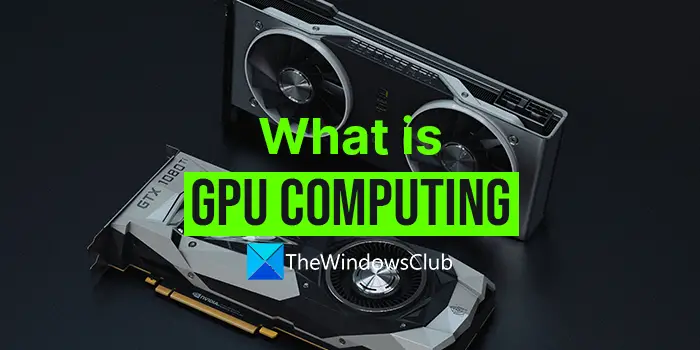
A Graphics Processing Unit or GPU in short is used as a co-processor along with the CPU for heavy tasks and computing.
Generally, GPUs are used to accelerate memory-intensive tasks such as image or video processing, rendering, or gaming. A GPU has become a necessity for such tasks, as it offers numerous cores and superior memory bandwidth.
Not only are GPUs used for memory-intensive tasks, but they are also increasingly used for scientific computing. It has become suitable for a wide range of computing tasks that require high CPU and GPU usage. GPU computing has steadily grown in performance and has never slowed down in computing tasks.
GPU offloads some memory- or compute-intensive tasks from the CPU and accelerates them. GPU, along with CPU, performing intensive tasks at greater speeds, is known as heterogeneous or hybrid computing.
What is GPU computing used for?
Usually, GPUs are used to accelerate graphics processing tasks such as image or video editing or gaming. GPUs have immense power to help the CPU perform intensive computing tasks, and they are now used for such tasks. In addition to gaming and content creation, such as video editing and graphics, GPUs are widely used in Machine Learning. In Machine Learning and AI, GPUs are primarily used for processing-intensive tasks such as image recognition.
Read: Best free tools to benchmark CPU and GPU on Windows computer
What are the advantages of GPU computing?
The advantages of GPU are beyond words. As mentioned earlier, a GPU can perform heavy computing tasks by offloading intensive processing from the CPU and working in parallel, delivering results faster. The lag-free games we play, the high-quality videos and images we see, and the AI services we use that deliver results in real time are advantages of GPU computing. In simple words, GPU computing is all about speed and parallel computing. So, whenever a computing task requires more CPU power and time, a GPU can help complete it faster.
The main advantages of GPUs include parallel computing, machine learning, multitasking, analytics, data science and Bitcoin mining.
What is GPU in a computer in simple words?
The tasks we perform on our PC are mostly handled by the CPU. There are some tasks that require more computing power or resources, like playing heavy games or editing images or videos. Then, the need for a GPU or Graphics Processing Unit arises. It works in parallel with the CPU and handles heavy tasks, allowing the CPU to focus on tasks that require less memory or computing power.
Read: What is GPU Sag, and How to keep GPU from sagging on PC
When should I use GPU in computing?
You can use GPU computing when you are doing heavy computing work, such as Machine Learning or implementing Artificial Intelligence. Even if you do not have Machine Learning or AI tasks, you can use GPU computing while playing heavy games on your computer or performing graphics processing, such as image editing or video rendering. GPU computing speeds up program response times and saves you time.
Read: Things to know before buying an external GPU for your PC
What is the difference between CPU and GPU?
Central Processing Units (CPUs) and Graphics Processing Units (GPUs) are both critical computing engines. The CPU has fewer cores than the GPU, so the GPU has more computing power. A CPU can perform several tasks at a time, but it takes longer than a GPU.
Read: How to check the GPU Temperature in Windows.
