
Proteins are dynamic molecules. Their structure and shape are not static. They keep changing their shape, a phenomenon known as Protein Dynamics. Proteins play an important role in almost all biological processes in humans and other organisms. Microsoft has developed Biomolecular Emulator-1 (BioEmu-1), a deep learning model designed to decode the dynamic behaviour of proteins. In this article, we will see what Biomolecular Emulator-1 is and how it can be a game-changer in the field of Protein Dynamics and Drug Discovery.
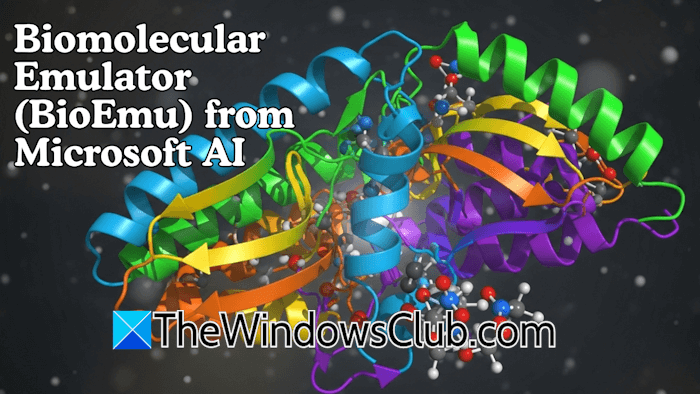
Microsoft’s Biomolecular Emulator-1 (BioEmu-1)
Predicting protein structures from the amino acid sequences helps scientists to understand how proteins interact with other molecules, which is crucial for developing new drugs and therapies. Molecular Dynamics (MD) simulation is a traditional method of predicting protein behaviour. The biggest limitations of MD simulations are that they are slow and have a high computational cost. Microsoft developed Biomolecular Emulator-1 to eliminate this limitation.
BioEmu-1 is a deep learning model that behaves like a simulator but is much faster. It can generate thousands of protein structures per hour on a single Graphics Processing Unit (GPU). This is a cost-effective solution compared to MD simulations, which often take days or weeks.
How BioEmu-1 works
Microsoft’s Biomolecular Emulator-1 is trained on a huge set of high-quality data, including the AlphaFold database, an extensive MD simulation dataset, and an experimental protein folding stability dataset. The AlphaFold database contains AlphaFold structure predictions for over 100 million proteins.
While preparing the SFDB (AlphaFold database), Microsoft’s Research AI for Science Team clustered similar protein sequences. This helps BioEmu-1 recognize that a protein sequence can map to several distinct structures.
The MD Simulation datasets, with a total length of 200 milliseconds, help BioEmu-1 predict physically plausible structural changes that a protein structure can adopt. The training data also includes around 500,000 experimental measurements of protein stabilities, which help BioEmu-1 predict the equilibrium between folded and unfolded states of protein.
This powerful training enables BioEmu-1 to predict relative free energies with 1 kcal/mol accuracy compared to millisecond-scale MD simulations.
Why BioEmu-1 can be a game changer?
Traditional MD simulations are resource-intensive and often require longer computational time. For example, a simple protein structure can take up to years of compute time when simulated in milliseconds on a modern GPU. BioEmu-1 is faster than MD simulations.
Apart from speed, BioEmu-1 can also accurately capture important motions, like domain rearrangements, local unfolding transitions, etc., vital to a protein’s functional dynamics.
Scientific validation of BioEmu-1
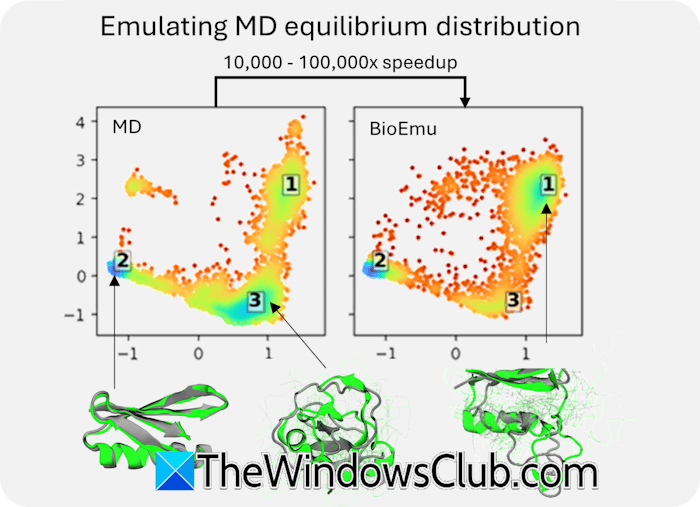
- LapD Protein: BioEmu-1 can predict the structures of the LapD protein from Vibrio Cholerae bacteria. In testing, it predicted both bound and unbound structural states of the LapD protein. Both these states are experimentally known but not present in the data set.
- Protein G: BioEmu-1 reproduced MD equilibrium distributions accurately with a tiny fraction of computational cost.
BioEmu is open-sourced under the MIT license and available at Azure AI Foundry and ColabFold. Developers can get its source code from GitHub. Its model weights are available at HuggingFace.
That’s it. I hope this helps.
What is the AI EXE from Microsoft?
The AI.exe or AI Host file is a part of the Microsoft Office applications. It is an executable file that is used by Microsoft Office applications to perform most AI tasks. After launching a particular Microsoft Office application, you can find it under the Processes tab.
Is Microsoft Copilot free?
Microsoft Copilot is free for all Windows users and available on the Microsoft Store. It can be used for general queries. However, to use its advanced features, you have to purchase the Pro version. Microsoft Copilot Pro is also available in all Microsoft Office applications.
Read next: How MAI-DxO from Microsoft is helping Doctors use AI.
