
As technology advances, computer hardware is upgraded to meet public demand. Earlier, there was a CPU (Central Processing Unit) in computer systems. Later on, the introduction of GPU (Graphics Processing Unit) has taken image rendering and image processing to the next level. Today in the age of Artificial Intelligence, we have TPU (Tensor Processing Unit). All three are processors that are developed to carry out specific tasks on a computer. In this article, we will talk about the difference between CPU, GPU, and TPU.
TPU vs GPU vs CPU Performance and Differences discussed
The CPU, or Central Processing Unit, carries out arithmetic and logical operations. A GPU, on the other hand, renders and processes images and graphics. TPU is a special type of processor developed by Google. It handles neural network processing using TensorFlow. CPU can do multiple tasks, including image rendering. But higher-level image rendering requires a dedicated processor, the GPU. That’s why high-end games always require a dedicated graphics card.
What is a CPU?
CPU stands for Central Processing Unit. It is the brain of a computer because it handles all the tasks that a user performs on his/her computer. The CPU performs all the arithmetic and logical calculations required to complete a task. The aim of the CPU is to take input from the devices connected to a computer, like a keyboard, mouse, etc., or from a programming software and display the required output.
Components of a CPU
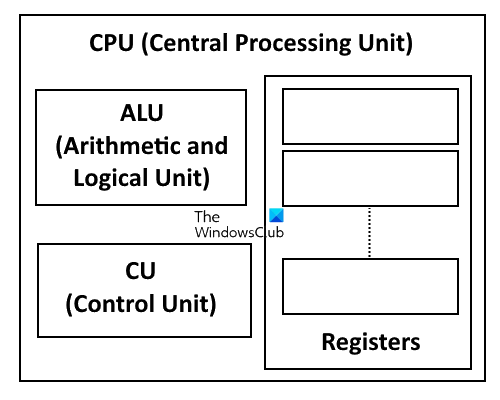
A CPU consists of the following three components:
- CU (Control Unit)
- ALU (Arithmetic and Logical Unit)
- Registers
Control Unit in CPU
A Control Unit (CU) is a CPU component that fetches instructions from main memory and decodes them into commands. These commands are then sent to the ALU, which executes the instructions, and the result is stored in main memory.
ALU (Arithmetic and Logical Unit) in CPU
ALU, as the name implies, is the component of a CPU whose work is to carry out arithmetic and logical calculations or operations. Further, an ALU can be split into two parts namely, AU (Arithmetic Unit) and LU (Logical Unit). The work of these two units is to perform arithmetic and logical operations respectively.
All the calculations required by a CPU are carried out by the ALU. ALU receives commands from the Control Unit. After receiving these commands, it processes them by doing calculations and then it stores the final result in the main memory. The following three operations are carried out by ALU:
- Logical operations: These operations include AND, OR, NOT, NAND, NOR, etc.
- Bit-shifting operations: Bit-shifting operation is the displacement of the bits to the right or left by a certain number of places.
- Arithmetic operations: Addition, subtraction, multiplication, and division are the arithmetic operations.
Registers in CPU
A CPU consists of several registers. These registers include both general-purpose and special-purpose registers. General-purpose registers store data temporarily. Special-purpose registers store the results of arithmetic and logical operations carried out by the ALU.
What are CPU Cores?
CPU cores are pathways consisting of billions of microscopic transistors. A CPU uses cores to process data. In simple words, a CPU core is a basic computation unit of a CPU. The number of cores is directly proportional to the computational power of a CPU. CPU cores determine whether a CPU can handle multiple tasks. You might have heard the following two types of CPUs:
- Single-core CPU
- Multi-core CPU
A single-core CPU can handle only one task at a time, while a multi-core CPU can handle multiple tasks at once. If you have a multi-core CPU installed on your system, you can do more than one task at a time, such as browsing the internet, creating a document or spreadsheet in Microsoft Office programs, and editing images at the same time. How many CPU cores you need depends on the type of work you perform on your computer.
What is a GPU?
GPU stands for Graphics Processing Unit. GPUs are used in a variety of applications, including image and video rendering. In gaming, graphics cards play a crucial role. A GPU is the main component of a graphics card. Graphics cards come in two types: integrated and dedicated. An integrated graphics card is built into the computer’s motherboard. Integrated GPUs cannot handle high-level tasks like high-end gaming. That’s why if you are a high-end gamer, you need to install a dedicated graphics card on your computer. Also, image and video editing tasks in heavy software require a dedicated graphics card.
Read: What is GPU Computing used for?
What is the difference between a GPU and a Graphics Card?
Though the terms GPU and Graphics Card are used interchangeably, they are not the same. Let’s see what the difference between these two terms is.
A GPU is a component of a graphics card, whereas a graphics card is a piece of hardware that is equipped with different components, including GPU, memory, heat sink, fan, etc. GPU is the heart of a graphics card because all the calculations required to process and render images are handled by GPU. Unlike a CPU, GPU has hundreds to thousands of cores. These small cores in a GPU are responsible for performing simple to complex calculations.
Read: Difference between DDR3 vs DDR4 vs DDR5 Graphics Cards.
What is a TPU?
TPU stands for Tensor Processing Unit. It is a processor developed by Google to handle neural network processing using the TensorFlow. TensorFlow is a free and open-source software library for artificial intelligence and machine learning.
Google’s TPU core consists of two units: the MXU (Matrix Multiply Unit) and the VPU (Vector Processing Unit). The Matrix Multiply Unit performs matrix calculations and operates in a mixed 16 – 32 bit floating point format, whereas the Vector Processing Unit performs float32 and int32 computations.
Google has developed Cloud TPU to offer maximum flexibility and performance to researchers, developers, and businesses. The main aim of developing TPUs is to minimize the time required to train large and complex neural network models. Cloud TPUs accelerate linear algebra computations used in machine learning applications. As a result, TPUs can reduce time to accuracy when training large, complex neural network models. If you train neural network models on hardware integrated with TPU, it will take hours, whereas, if the same task when done on the other hardware can take weeks.
Read: Do more CPU cores mean better performance?
TPU vs GPU vs CPU: Comparison based on different factors
Let’s compare these three processors on different factors.
Cores
- CPU: The number of cores in a CPU includes one (single-core processor), 4 (quad-core processor), 8 (octa-core processor), etc. The CPU cores are directly proportional to its performance and also make it multitasking.
- GPU: Unlike a CPU, a GPU has several hundred to several thousand cores. These cores carry out calculations. Hence, the GPU performance also depends on the number of cores it has.
- TPU: According to Google, a single Cloud TPU chip has 2 cores. Each of these cores uses MXUs to accelerate the programs by dense matrix calculations.
Architecture
- CPU: A CPU has three main parts, namely, CU, ALU, and Registers. There are 5 different types of registers in a CPU. These registers are:
- Accumulator
- Instruction Register
- Memory Address Register
- Memory Data Register
- Program Counter
- GPU: As explained above, there are several hundred to several thousand cores in a GPU. These cores perform all the calculations required for image processing and rendering. Architecturally, the internal memory of a GPU has a wide interface with a point-to-point connection.
- TPU: TPUs are Machine Learning accelerators designed by Google. Machine Learning accelerators can boost Machine Learning tasks. A TPU’s cores comprise an MXU and a VPU, which handle matrix and floating-point calculations, respectively.
Power
- CPU: The power consumed by a CPU depends on the number of cores it has. An octa-core processor consumes power approximately from 95 to 140 watts, whereas a 16-core processor consumes approximately 165 watts of power.
- GPU: A GPU can consume up to 350 watts of power.
- TPU: In a TPU, the process of reading and writing is performed on buffer and memory due to which power optimization can be achieved.
Read: What is System on a Chip (SoC)?
Is TPU or GPU better?
Both TPU and GPU are processing units. The former is the Tensor Processing Unit, and the latter is the Graphics Processing Unit. These processors do different work. As part of a graphics processor, the GPU performs the calculations required to render images. TPU is designed to handle neural network processing using TensorFlow.
Which one is better depends on the type of applications you are using them for. Cloud TPUs are optimized for specific workloads. In some situations, using a GPU or CPU is better for running machine learning workloads. Let’s look at when you should use a TPU versus a GPU.
The use of GPU is better than TPU for medium to large models with larger effective batch sizes, the models with TensorFlow are not available on Cloud TPU, etc.
TPUs are better than GPUs for models that require matrix calculations, take weeks to months to train, and use larger effective batch sizes.
Is TPU faster than CPU?
TPU is the Tensor Processing Unit. Google developed it to handle neural network processing using TensorFlow. The aim of designing TPU is to minimize the time required to train neural network models. According to Google, training neural network models on TPU-integrated hardware takes hours, whereas the same can take weeks to months on other hardware. Hence, TPUs are faster than CPUs.
