
Open-weight models give developers and end users more customization options. They run on our own devices and help us keep our data from reaching external servers. With open-weight models, developers can eliminate API and subscription charges and take a more independent approach to using models for research and development. Meta has released Muse Spark Open, touted as the most capable US Open-weight model. It is also available for developers on Microsoft Foundry. In this guide, we explain what developers need to know about the Muse Spark Open model available on Microsoft Foundry.
Meta Muse Spark Open Model on Microsoft Foundry: What Developers need to know
Meta Muse Spark is available on Microsoft Foundry as a generally available (GA) model. Let’s look at its strengths and how you can use this open-weights model as a developer.
- Capabilities of Meta Muse Spark Open
- Performance of Meta Muse Spark Open on key benchmarks
- Meta Muse Spark Open pricing
- Safety of Meta Muse Spark Open
Let’s get into the details.
Capabilities of Meta Muse Spark Open
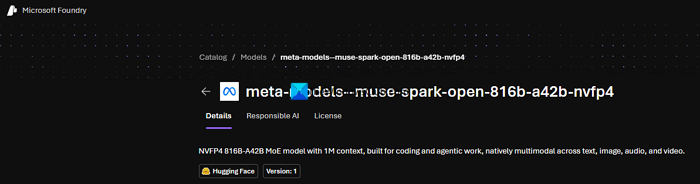
Meta claims Muse Spark Open is the most capable open-weight model from the US. Meta gives full control over the usage and products they choose to build. Muse Spark Open comes with 816B total/42B active parameters as an open-weight model with a context window of 1M tokens. Meta built Muse Spark Open as a multimodal model to make it the best in coding and agentic work.
Muse Spark Open performs well at multi-step reasoning and has capabilities to sustain coherent plans across complex reasoning chains over long horizons with extended workflows. As it is built as an agentic model, it is capable and can perform well in multi-step planning, invocation of sequential tools, and failure recovery, long-term horizon task execution, working within scaffolds, writing and debugging code, and can resolve multi-turn requests from start to finish. Coding agents powered by Meta Muse Spark Open can write, debug, and resolve real-world software engineering tasks with exceptionally good output.
Multimodal reasoning is one of the standout capabilities of Meta Muse Spark Open. It can interpret screenshots, charts, documents, images, audio and video recordings, and in-conversation rich environments. It performs well in synthetic data generation as training data for downstream model development. It can even serve as an evaluator for other models’ output.
Meta Muse Spark Open is trained as a multilingual model with training data from more than 100 languages and has a vocabulary size of 202,048.
Performance of Meta Muse Spark Open on key benchmarks
Meta Muse Spark Open performs with the best numbers in all major benchmarks. The benchmarks include JobBench and MCP-Atlas for Agentic task capabilities; it performs exceptionally well with a higher score than other open-weight models available, like Inkling, Nemortron 3 Ultra, Beam, etc. It scores a lot better and higher than other powerful open-weight models in knowledge & reasoning benchmarks like HLE-Diamond, SciCode, and AA-Omniscience.
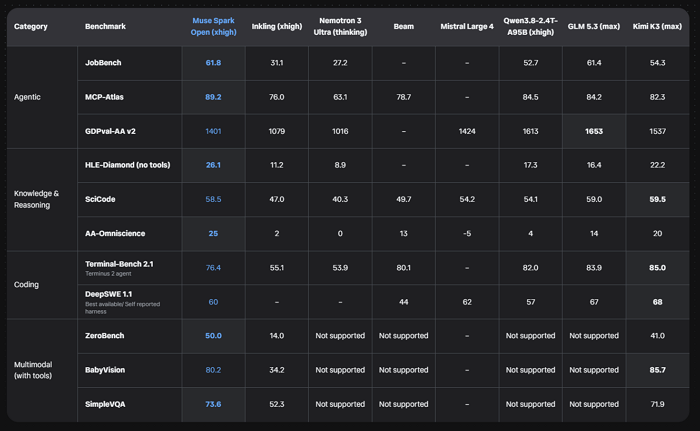
Terminal-Bench 2.1 and DeepSWE 1.1 benchmarks for coding have better scores and can be compared to Mistral Large 4 and GLM 5.3 (max). Very few open-weight models are built as multimodal tools, and Muse Spark Open performs exceptionally well, scoring higher than all existing models on benchmarks like ZeroBench, BabyVision, and SimpleVQA.
Meta Muse Spark Open pricing
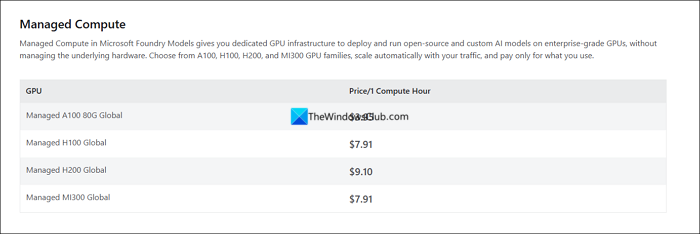
Meta released Muse Spark Open under the Muse Model License, usable for free with limited commercial terms to allow developers to build exciting products with it. The open-weight model is free to use and run in local environments. To use the model on Microsoft Foundry, you need to have a Foundry subscription that allows you to use the model and run it on Azure environments with better capabilities, computing, and safety protocols.
Safety of Meta Muse Spark Open
Meta claims that giving their models for public use as open-weight models is a part of their safety work allowing developers around the world to use it as a superintelligence model for their work. Muse Spark Open includes additional post-training safety protocols that Meta tested extensively. Across all risk categories Meta tested, the results showed strong safeguards to prevent misuse. Muse Spark Open is evaluated in line with Meta Superintelligence Scaling Framework that covers most severe risks. The results met their thresholds for public release.
Read: Best Open-Source Coding Model that runs on Windows Laptops
Is Meta Muse Spark Open an open-source model?
No, Meta Muse Spark Open is not an open-source model, but an open-weights model. OpenAI, Claude, and other models train their models and release them for public use. Users can only interact with and see the results from those models. Open-weights models, by contrast, are for public use, with all internal knowledge and settings available for the public to see, examine, use, and tweak for better performance.
How do I access Meta Muse Spark Open?
Meta Muse Spark Open is available on Microsoft Foundry, PyTorch, AWS, Hugging Face, OpenRouter, and all other major AI platforms. We can even download the model on capable personal devices and run it through the recommended tools like vLLM, SGLang, etc. Meta claims that Muse Spark Open is well-suited to run on Apple Silicon devices.
