
When you turn on your PC, a lot happens behind the scenes, starting with detecting connected hardware. When you have multiple external drives or USB HDD connected to a PC, the UEFI or BIOS will wait for the drives to boot up and check if it needs to boot up from which of the connected storage.

Why does the External HDD make the boot slow?
These are a few possible reasons why your boot experience with external storage is slow:
- UEFI or BIOS waits to figure out from where to boot the PC
- Presence of multiple active partitions
- Slow HDD start
- Outdated BIOS/UEFI version
Make Windows ignore external USB HDD during boot
Use these suggestions to figure out how you can avoid a slow boot of the PC, by making Windows OS ignore an external USB HDD during boot.
- Remove the external HDD from the boot list or change the order
- Disable Handshake or similar setting in BIOS.
- Re-Enable Fast Boot
- Update BIOS or UEFI.
Make sure to use an admin account, and you have a clear understanding of the technicality. Also, these suggestions assume that you must keep the devices on every time you turn on the PC.
1] Remove the external HDD from the boot list or change the order
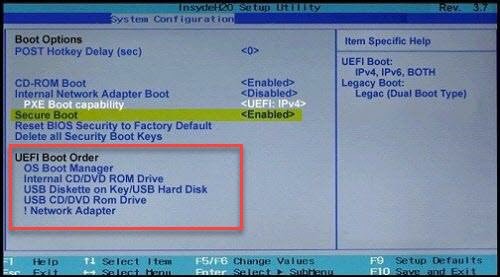
If the BIOS/UEFI allows it, check whether you can remove the external HDD from the Boot list. If not, make sure the drive with Windows is first in the boot order. This will ensure no other drive or USB drives are checked for boot records.
While you can disable POST or any hardware checks BIOS/UEFI offers, these checks are there for a reason, and they should be there.
2] Check for Active partition on external HDD
An active partition on HDD means the BIOS/UEFI will check on it to determine if there is a bootable OS. So the best approach to this is to set it as inactive using the disk tool, which is available in Windows
3] Re-Enable Fast Boot or Fast Startup
If you are using Fast Boot, it could have some settings stored that are confusing things. Especially if you are sometimes booting with the drive plugged in and sometimes not. When you re-enable Fast Boot, Windows will remove the fastboot file, and any configuration or data stored in it will also be removed. Later, when you enable it, it will recreate the file. Make sure that the HDD is connected when doing so.
To make sure, follow these steps.
- Go to Windows Control Panel, and go to Power Options.
- Click on Choose what power buttons do link.
- Then click on Change settings that are currently unavailable
- Uncheck Turn on Fast Startup

- Turn off Fast Boot and shutdown (not restart).
- Then boot normally and ensure that external drives are plugged in.
- Reenable fastboot
- Shutdown so it writes a new fastboot file.
- Start it up and see if the boot time improves.
4] Update BIOS or UEFI
Check if there is an update to your BIOS or UEFI. A recent motherboard hardware update may have fixed these kinds of problems. It’s a long shot, but it is worth trying if nothing else works.
Note: Updating firmware can be tricky. Make sure you follow the OEM’s guidelines to upgrade.
What if nothing else works?
If none of these solutions work and you need to keep the devices connected all the time, you could plug them through a hub that can be timed to turn on a few seconds later. Devices such as a timed relay/transistor can be helpful.
I hope the post was easy to follow, and that you can ignore the external USB HDD during boot to speed up boot times using these suggestions.
Can I use an external HDD as a bootable USB?
Yes, it is possible to use external storage, an HDD or an SSD, as a bootable drive as long as it has an active partition and Windows installed. However, if you connect it to another PC, you’ll need to install all hardware-related software, and Windows activation may become questionable.
How do I boot from USB in BIOS?
You need to change the boot order in the BIOS/UEFI to boot from a bootable USB. This ensures the motherboard looks for a bootable partition on the USB drive first, then on the internal storage device.
