
There are two major encryption protocols available right now and they are Secure Socket Layer (SSL) and Transport Layer Security (TLS). The question is, what are they, and do these protocols even work today? We are going to discuss the differences between them and more in this article.
Difference between TLS and SSL explained
SSL and TLS are similar technologies because they share a codebase, though one is better than the other. In fact, one is dead, and the other still reigns supreme to this day. By the end of this article, you should learn quite a lot about both security certificates.
What is SSL or Secure Socket Layer?
SSL stands for Secure Sockets Layer, and to get straight to the point, it’s the standard technology used to keep your internet connection secure. It can safeguard all sensitive data that is being delivered between two systems, and because of this, it prevents criminals from reading or modifying the transferred information.
As for the two systems, they can be a client and a server, for example, The Windows Club (website) and your favorite web browser. The two systems can also be two servers communicating with each other.
How does SSL work?
SSL provides protection by ensuring that any information transferred between users and websites, or between two computer systems, remains difficult to read. It uses encryption algorithms to scramble data in transit, aiming to prevent hackers from gaining access while it’s being sent over the connection.
Compared to TLS, SSL is more complex to implement, and it uses MAC, or message authentication code, after message encryption to ensure data integrity. When it comes down to creating a master secret, then, SSL uses a message digest to get the job done.
What is TLS or Transport Layer Security?
TLS stands for Transport Layer Security, and it’s very similar to SSL but more secure. Since SSL is widely popular and known, many have decided to refer to TSL as SSL. As you browse the web, look for a padlock icon in the address bar. If you see it, then know this: it’s because TLS is active, not SSL, as some might believe.
How does TLS work?
It works very similarly to SSL, but is better in terms of security; still, it is unique in some ways. You see, TLS uses a hash-based message authentication method in its record protocol, whereas SSL does not.
Not only that, but TLS is simpler than SSL. Furthermore, it utilizes a quasi-random function to create a master secret.
Note that TLS is not in the business of securing data on end systems. The standard is there to secure the delivery of any data over the internet, which can avoid eavesdropping among other things.
The history behind SSL and TLS
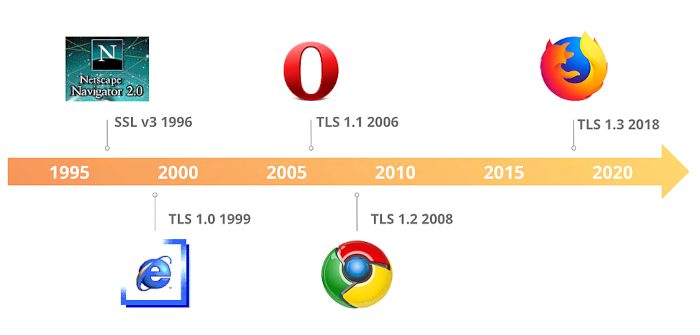
Here’s the thing, SSL was created and introduced back in 1994 by the Netscape Communication Corporation. The standard underwent several upgrades, but due to security concerns, version 1.0 was never released, and as such, SSL version 2.0 was the first public release in 1995.
In 1996, version 3.0 of SSL was released to address security vulnerabilities. Newer versions were never released in the years to come, and due to the 2014 POODLE attack; version 3.0 was officially put to bed in 2015.
When it comes to TLS, it made its debut in 1999 as an upgrade to SSL version 3.0. The plan was to use TLS over TCP to encrypt applications such as FTP, IMAP, SMTP, and HTTP. For example, HTTPS is a secured version of HTTP because it makes use of TLS to protect data delivery.
The differences between Secure Socket Layer & Transport Layer Security
As we have laid out above, the differences are not plentiful. The most important is how they establish connections. SSL uses a specific port for connections, while TLS uses an implicit connection via a protocol. This makes TLS more secure than SSL, especially since all versions of SSL have been compromised and are no longer in use anywhere on the web.
Overall, despite their minor differences, their primary goal is to use a cipher suite to decide the overall security of the internet connection.
That’s it!
Why was SSL replaced with TLS?
The replacement has everything to do with the security vulnerabilities faced by SSL version 3.0 back in 2014. TLS (Transport Layer Security) is the successor and improved version of SSL. With its recent versions, there are many other improvements and performance benefits with TLS. All major web browsers have replaced SSL with TLS, and we expect this to be the case across the World Wide Web in the years to come.
Does TLS use SSL encryption?
The TLS communication session begins with a TLS handshake using asymmetric encryption. At one end of the communication, a public key is used, and a private key is used at the other end (on the server side) via public-key cryptography to exchange randomly generated data.
Read next: Difference between HTTP and HTTPS.
