
Some Windows errors are very commonly encountered. You may encounter them every once in a while. One such error you may encounter while opening a .exe file is: Windows cannot access the specified device, path or file, You may not have the appropriate permissions to access the item.
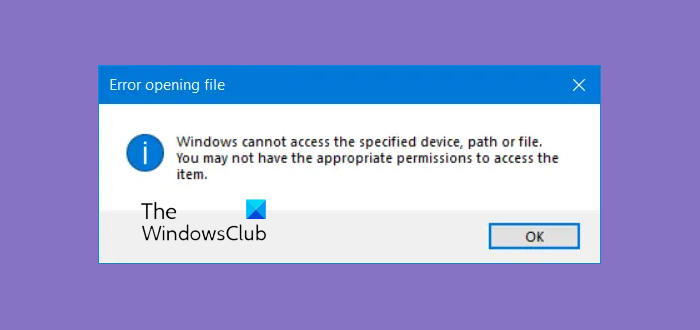
This error message can be related to files such as svchost.exe, regsvr.exe, spoolsv32.exe, taskmgr.exe, sys.exe, rundll.exe, explorer.exe, csrss.exe, winupdate.exe, or any .exe program file installed on your Windows computer.
Maybe these system files have been corrupted due to malicious infections, and maybe your antivirus may have deleted the system file because your PC was infected by one of the malicious programs – the reasons could be many. If a system file is causing the problem, running the System File Checker might be a good idea.
What does Windows cannot access the specified device, path or file mean?
It is clear from the error message that you do not have permission to access the file or the location where the file is placed. Hence, this error is mainly caused by permission issues. You may also see this error if your antivirus is blocking the file.
Windows cannot access the specified device, path or file, You may not have the appropriate permissions to access the item.
Here are a few troubleshooting steps you may try to fix the error. But you will have first to ensure that the file is not in a location that is currently accessible, like maybe a network location or an external drive that is not currently connected to the PC, etc. Also, check that the file has been moved or deleted.
1] You don’t have read or write permission to the specified path
Check if you have permissions to open the file. If required Run as administrator and see if it helps. Else you may have to take ownership of the file. You may use our Ultimate Windows Tweaker to add the Take ownership of Files and Folders option to Windows 11/10.
Tip: RegOwnit lets you take full control & ownership of Windows registry keys.
2] Check the shortcut
If it is a shortcut that you are clicking on to open the file, you may want to check if the target file is still located at the destination. If so, the shortcut itself may have been corrupted. Delete it and create a new shortcut.
3] Ensure that the file has not been deleted
Browse to the file’s location and verify that it exists, as you may receive this error if the file has been moved.
4] Shortcut corrupted
Maybe the shortcut has become corrupted. Recreate it and see.
5] Check the location
Check if you are attempting to access a location that is not currently available such as a networked or a removable drive.
6] This file came from another computer and might be blocked to help protect this computer
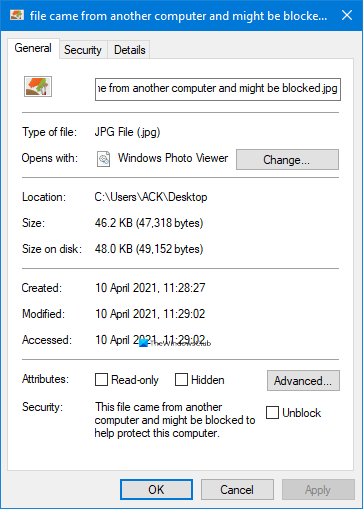
If the file was downloaded from the Internet, right-click the file and select Properties.
Under the General tab, towards the bottom you will see classified under Security: This file came from another computer and might be blocked to help protect this computer.
Click on Unblock. Click Apply > OK. This should help.
Related: You need permission to perform this action on Windows 11/10.
7] Check if your antivirus software is blocking the file
You may also want to check if your antivirus software is blocking the file for some reason. If you are convinced the file is safe, temporarily disable your security software and try to open it again.
I hope something helps you!
Related: Windows cannot find Make sure you typed the name correctly.
How do I enable access permission?
If you are unable to access the file due to permission issues, first check whether you are signed in to Windows 11/10 with an administrator account. If, despite logging in to Windows 11/10 with an administrator account, you cannot access the file, you must take ownership of the file to enable access permissions.
