
VPN stands for Virtual Private Network. It is a secure way of accessing the internet. When we surf the internet, data is sent to and from our device in the form of packets. If we are connected to a public or insecure network, our systems become more vulnerable to cyber-attacks. This is because data sent by our device over a public or open network can be easily accessed by a hacker. Moreover, if you visit websites that do not use SSL encryption, your sensitive information can be easily stolen by hackers. Another risk of browsing the internet via a public or open network is a virus or malware attack. A hacker can easily have control of your system by injecting malware.
A VPN creates a secure tunnel through which data is sent to and from your system. In other words, all the data that your device sends and receives remains encrypted. This is why organizations provide VPN connections to their employees for internet surfing. Because a VPN encrypts your data and routes it through a secure VPN server, you may experience slower internet speeds in some cases. If many users connect to the same VPN server, the load on the server increases, slowing internet speeds. VPN Split Tunneling is the solution to this problem. In this article, we will discuss what a VPN Split Tunneling is and what its advantages and disadvantages are.
What is VPN Split Tunneling?
VPN Split Tunneling provides you with more control over your VPN connection. If you enable VPN Split Tunneling, some of your internet traffic is sent through the VPN tunnel and the rest of your internet traffic is sent through an open or regular internet connection. VPN Split Tunneling lets you select which internet traffic you want to send through the encrypted tunnel (VPN).
How does the VPN Split Tunneling work?
Let’s understand how the VPN Split Tunneling works. As described above, the VPN provides you with two connections simultaneously: one encrypted and the other unencrypted. You can use the encrypted connection for websites where you need to enter confidential or sensitive information, such as banking websites. For other trusted websites where you do not need to enter sensitive information, such as watching videos on YouTube or downloading software or files from trusted sites, you can use your regular connection.
On the other hand, if your VPN connection does not support split tunneling, everything you surf on the internet has to travel through the VPN tunnel, which in turn slows down your internet speed. If you do not want to experience slow internet speeds, disconnect your system from the VPN for regular internet surfing, and reconnect it when making online transactions, accessing your organization’s server, etc.
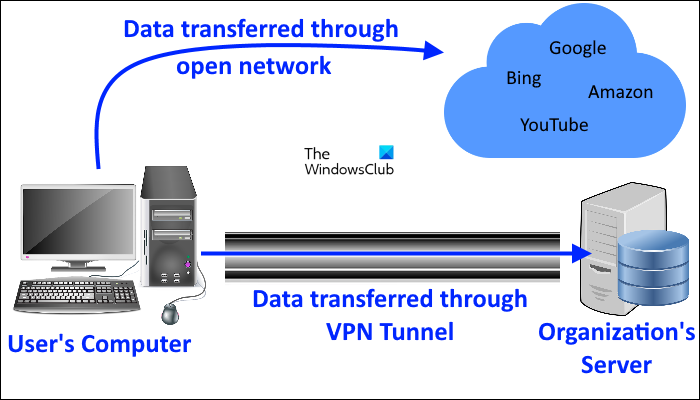
As you can see in the above screenshot, when a user accesses the organization’s server, the data from its computer is sent through the VPN Tunnel. Whereas when he tries to access other websites, such as Amazon and YouTube, the data is transferred over an open network. After enabling the VPN Split Tunneling feature, you need to add the websites you want to use the VPN for. After configuring it properly, whenever you visit such websites, your data will be transferred through the VPN Tunnel, and for other websites, it will be transferred over an open network. This is how VPN Split Tunneling works.
Read: What is Cyber Crime? How to deal with it?
Is VPN Split Tunneling good or bad?
Above, we have discussed what VPN Split Tunneling is and how it works. Now, let’s talk about its advantages and disadvantages. If you are wondering whether you have to use VP Split Tunneling or not, the pros and cons of VPN Split Tunneling described below will help you make your decision.
Pros of VPN Split Tunneling
The following are some advantages of VPN Split Tunneling:
- VPN Split Tunneling helps conserve bandwidth. Because all your internet traffic is not sent through the VPN server, you will not experience slow internet speeds while using the VPN Split Tunneling.
- You can access more than one network at a time. VPN Split Tunneling divides your internet connection into an encrypted and an unencrypted connection. If your VPN supports split tunneling, you can use both networks at the same time, eliminating the hassle of repeatedly connecting and disconnecting your system from the VPN server while doing official and unofficial work.
- It provides a secure connection to the remote workers. The VPN Split Tunneling lets employees transfer files and confidential data over the secured VPN server and at the same time, they can access other resources on the internet through their regular internet connection.
Cons of VPN Split Tunneling
The following are some disadvantages of VPN Split Tunneling:
- It makes an organization’s server prone to cyber-attacks. VPN Split Tunneling allows a person to use both a VPN secure network and an open network at the same time. If a remote employee visits a malicious website, his computer can be attacked by malware. At the same time, the malware can enter the organization’s server and cause damage. In this way, a hacker can steal an organization’s confidential data.
- Employees can bypass the permissions set up by an organization. While providing remote work to their employees, organizations usually block some websites on their servers which prevents their employees from accessing those websites. If an organization provides its employees with VPN Split Tunneling, they can bypass permissions and access blocked content, increasing the organization’s security risk.
- VPN Split Tunneling is not available on all VPNs. Not all VPN providers offer a VPN Split Tunneling facility to their users.
Closing Words
VPN Tunneling is a good way to keep your sensitive data secure while surfing the internet without slowing down your internet speed. But if online security and privacy are your main concerns, you should avoid VPN Split Tunneling and use a VPN for all your internet traffic. By doing so, you have to compromise internet speeds, but your data remains secure while surfing the internet.
That’s it.
Read: Should Cookies be Enabled or Disabled in my Browser?
Should I use Split Tunneling on VPN?
It depends on you. If you have installed high-end security software on your system that provides the same security measures as your organization, you need not use VPN Split Tunneling. On the other hand, if you do not have such software, you need to use VPN Split Tunneling for traffic to your organization’s server.
Why do we use split tunneling?
VPN Split Tunneling is used when a user wants to use an encrypted, secure network and an open network at the same time. Organizations use VPNs to secure their data from hackers. When we surf the internet, our data is transferred in packets. The more packets a VPN server receives, the slower the speed of the internet connection is. If an employee uses the organization’s VPN to access everything over the internet, it will reduce internet speed. Hence, to save bandwidth, organizations provide split tunneling to their employees so they can use the VPN only for work and a regular internet connection for other tasks.
Read next: Best Cybersecurity Practices for Small Business.
