
Microsoft offers DirectX Raytracing or DXR in short with Windows 11/10. With the first generation of hardware, gamers can use ray tracing to build shadows, light, and effects around it in real-time. In this post, we are looking at DirectX Ray tracing in Windows 11/10 and what it means for Gaming.
What is Ray tracing?
In simple words, ray tracing means calculating how light would fall on objects, how it looks after the light is reflected from that object, and the effect of light that falls on some other object. This helps developers to create a better visualization of their characters and scenarios.
That said, it’s nothing new, and it’s not something that has been created by Microsoft either. Developers had been using this from CGI times, and it involved pre-calculating the brightness of virtual objects before shipping their games. So there was no real-time ray tracing until now.
DirectX Ray Tracing in Windows 11/10
There are two parts of ray tracing. It needs support from both Hardware and Software. Starting with the Windows 10 v1809 update, DirectX Raytracing will work out of the box on supported hardware. This means you will need to change your graphics card to one that supports native ray tracing.
Microsoft has made sure that DirectX Raytracing API is built such that it works across hardware from all vendors. The best part of all this is that ray tracing is now real-time. Developers do not need to perform any precalculatio,n as Game developers now have access to both the OS and hardware to support real-time raytracing in games.
DirectX Ray tracing works with Existing Engines
To date, the industry has been using traditional rasterization to achieve more realistic scenes in games. It lacked reflections, shadows, and ambient occlusion. All these changes with DirectX Raytracing, with API developers, can be used alongside rasterization-based game pipelines to integrate DirectX Raytracing support into their existing engines. This means there is no need to rebuild the engines at all.
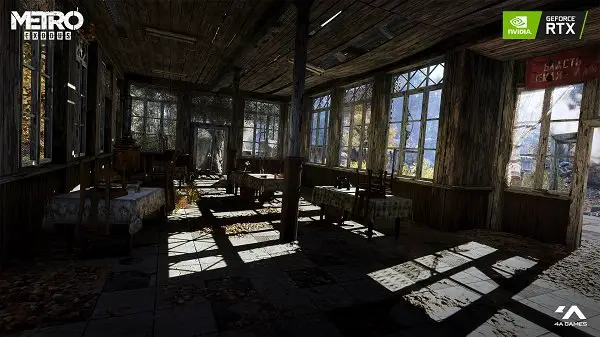
Microsoft has also shared that several studios have partnered with NVIDIA, which created RTX technology to make DirectX Raytracing run as efficiently as possible on their hardware. Here are some sample images from games like Battlefield V, Shadow of the Tomb Raider, and Metro Exodus.
Currently, developers are going to build games using both rasterization and ray tracing. The latter is going to be majorly used to calculate the shadows or reflections, while most of the content is generated with the former tech.
DirectX Ray tracing API
The Redmon giant has also made sure that DirectX Raytracing is future-proof, and well-aligned with the future evolution of GPUs: DXR workloads will fit naturally into the GPU pipelines of tomorrow.
In addition to hardware, the recently announced public API, DirectML, will allow game developers to integrate inferencing into their games with a low-level API. On higher level:
- Acceleration structure: Object that represents a full 3D environment.
- DispatchRays: It is the starting point for tracing rays into the scene.
- A set of new HLSL shader types, including ray-generation, closest-hit, any-hit, and miss shaders.
- Raytracing pipeline state
That said, it doesn’t introduce any new engine but works on any DirectX 12 engine.
Microsoft is betting big on DirectX Ray tracing
As the gaming industry progresses to higher resolution and the human eye is looking for more realistic views, Microsoft expects that even small glitches can be resolved. The human eye can catch a small deviation from the real world because it doesn’t feel right. DirectX Ray tracing will help developers blur the line between the real and the fake.
What do you think of DirectX Ray tracing? Do you think we will see better games in the coming years? Let us know in the comments.
