
Have you ever heard of Access Control List (ACL)? This is very important when it comes to computer security. In this article, we will discuss what ACLs are and the types of ACLs available right now.
What is Access Control List (ACL)?
For folks who want to learn what ACLs are, among other things, we suggest reading the information below, as it contains everything you need to know.
- What does ACL stand for?
- What are ACLs, then?
- Why should we use ACLs?
- Where possible, can we place an ACL?
What does ACL stand for?
Many have been wondering what the acronym ACL stands for. Well, it means an Access Control List, and it’s very important when it comes to network devices.
What are ACLs?
ACLs are a set of rules that monitor incoming and outgoing traffic. From there, it will compare it with a set of defined statements. Now, we should also note that ACL is one of the most fundamental components in network security.
Additionally, an ACL and a Stateless Firewall are essentially the same thing in that they only allow, block, or permit packets to flow from the source to the final destination.
When it comes to where ACLs are usually found, we can say for certain that they are found in routers or firewalls. However, users can configure ACLs to apply to devices that operate on or within a network.
Why should we use ACLs?
The reason for using ACL is to provide security to a network. If ACL is not in place, any traffic is allowed to enter or exit, which is bad because unwanted and dangerous traffic could slip through.
When it comes to improving security with ACLs, users can choose to deny specific routing updates or implement traffic flow control, for example.
Read: The Access Control List (ACL) structure is invalid
Where can we place an ACL?
Devices connected to the Internet need a way to filter traffic; therefore, one of the best places to configure ACLs is on edge routers. From what we’ve come to understand, a routing device that supports ACLs can be positioned to face the Internet and connect to a buffer zone that separates the private network from the public Internet.
Furthermore, the option is available to configure an ACL to protect against specific ports, such as TCP or UDP.
What are the different types of ACLs?
There are two types of ACLs, as far as we know, and they are Standard Access Lists and Extended Access Lists. Let us explain what these are about.
- Standard Access Lists
- Extended Access Lists
1] Standard Access Lists
When it comes down to the Standard Access Lists, it is only possible to source the IP address of a packet. We should point out that these types of Access Lists are not at the same power level as Extended Access Lists, but the good news is that they do not require much processor power from the router.
2] Extended Access Lists
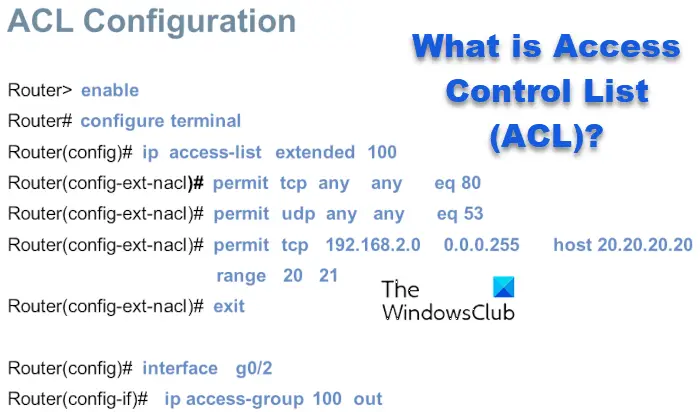
If you choose to use Extended Access Lists, expect more precise filtering than with Standard Access Lists. Additionally, users can easily evaluate destination and source IP addresses, source and destination ports, layer 3 protocols, and more.
Bear in mind that an Extended Access List is more difficult to configure and will consume more processor power than the Standard Access List. However, you are given greater control.
Read: What is Data Science, and how do you become a Data Scientist?
What are ACLs used for?
Access Control List is a defined set of rules designed for controlling network traffic, along with reducing network attacks from hackers. ACLs are also used to filter traffic based on specific rules for the computer network’s incoming and outgoing traffic.
What are the benefits of Access Control List?
- Better security of internet-facing servers.
- More authority of access through entrance points.
- More control of access to and traffic between internal networks.
- More granular control of the user and group permissions.
I hope this helps.
