
Cyber threats are on the rise and with increased complexity in targets, Microsoft aims at making the user aware of the sources and types of malware that can affect his/her computer from anywhere in the world. This lets consumers and enterprise alike be knowledgeable before the attack takes place. In this post, we will explain what is a Trojan Virus in computers.
What is a Trojan virus?
A Trojan horse is a type of malware that disguises itself as useful software. The aim is for the user to execute the Trojan, which grants it full control of the PC and the ability to use it for its purposes. Most of the time, malware will be installed on your systems, such as backdoors or keyloggers.
The delivery method used is normally social engineering. Malicious code is hidden within legitimate software. Once it is downloaded to your computer disguised as a legitimate program its gets to work.
How do Trojans work
Like the famous Trojan horse, software Trojans hide inside files or images or videos and then download malware on the host system.
They typically work like this:
- Backdoor Trojans provide attackers with remote unauthorized access to and control of infected computers
- Downloaders or Droppers are Trojans that install other malicious files to a computer they have infected, either by downloading them from a remote computer or by obtaining them directly from copies contained in their own code.
Now that you know what trojans are and how they can infect systems, you need to be extra aware and keep a lookout for fishy and ‘clickbait’ material on the Internet. Additionally, you can encourage employees in your organization to use personal devices for social media and web browsing instead of relying on devices connected to your corporate network.
What are Remote Access Trojans
Remote Access Trojans (RAT) have always proved to be a big risk to this world when it comes to hijacking a computer or just playing a prank with a friend. A RAT is malicious software that lets the operator attack a computer and gain unauthorized remote access to it. RATs have been here for years, and they persist as finding some RATs is a difficult task even for the modern Antivirus software out there.
Trojan use is on the rise
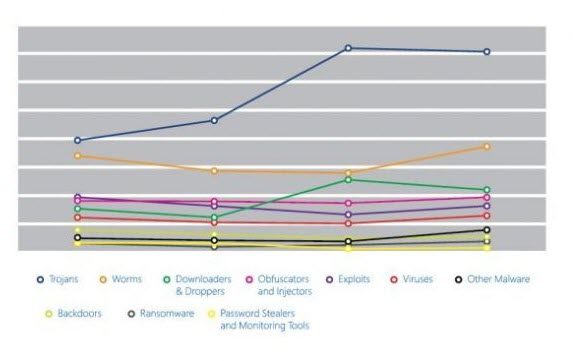
Trojans, the study reveals, are the most prevalent form of malware used by attackers. Research showed that encounters involving Trojans increased by fifty-seven percent and stayed elevated through the end of the year. Trojans accounted for five of the top ten malware groups encountered by Microsoft real-time antimalware products.
The increase was largely due to Trojans known as Win32/Peals, Win32/Skeeyah, Win32/Colisi, and Win32/Dynamer. Also, a pair of newly detected Trojans, Win32/Dorv, and Win32/Spursint, helped account for the elevated threat level.
An important observation in the report was that, although the total number of attacks was more frequent on client platforms, the incidence of Trojans was higher on server platforms, which enterprises typically use. Trojans accounted for three of the top ten malware families and four of the top ten malware and unwanted software families most commonly encountered on supported Windows server platforms.
These observations show that all kinds of malware attacks have varying effects on the different operating system and their versions. Although the frequency may depend on the popularity of a certain OS, it is mostly a random and variable factor.
You can read the difference between Virus, Trojan, Worm, Adware, Spyware, Rootkit, Malware, Backdoor, etc. here.
