
Why should only astronauts get to enjoy the experience of living in space? Because they are astronauts! But what’s the harm if the rest of us can at least get a glimpse of what it’s like? That’s what the developers of NASA’s Eyes had in mind while creating the app. Let’s see how far we can explore space with this new app developed by the California Institute of Technology.
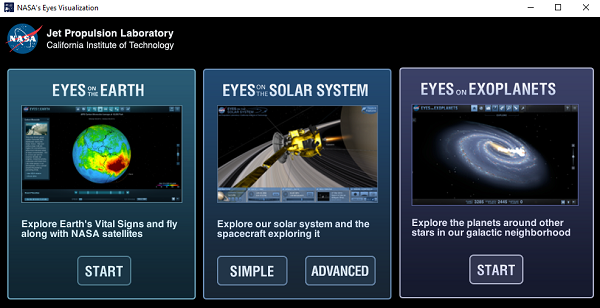
NASA’s Eyes for Windows PC
Things NASA’s Eyes shows you
NASA’s Eyes will notify you of all the particular celestial movements happening in the universe. It will give complete information at the right time, something you cannot expect from the official NASA websites or its YouTube channel. The app will allow you to view all of the space’s natural and human-made satellites. You can call the app a space museum if you like.
You also get information about the latest NASA research and the parts that are not ‘classifieds.’ You get to know a lot about the floating objects in space that you won’t get to know about merely from the internet. What’s awesome is that all this comes at no cost. Yes, there’s no catch there. The app is free. You can easily install it on any popular version of Windows. The installation is quick and easy. No rocket science is needed for that. However, the app’s operation is also easy. It would help if you treated it as an encyclopedia.
The different modules offered
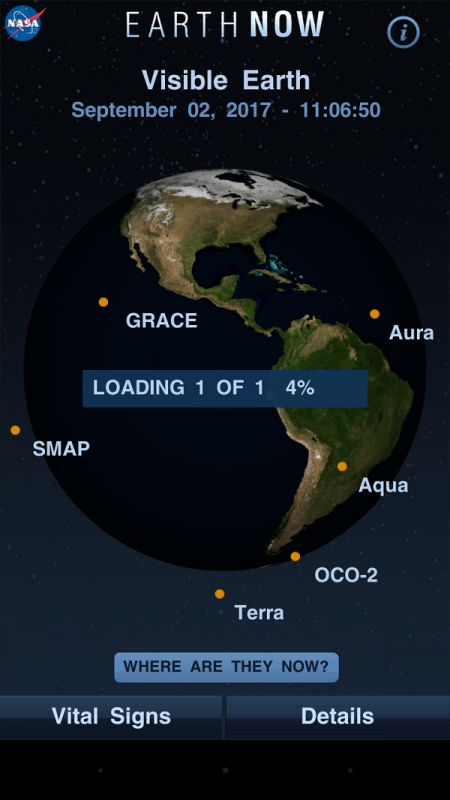
The app has a three-module format. The first one is called Eyes on the Earth. As the name suggests, this one deals with NASA activity happening on Earth and within its atmosphere.
The second module is Eyes on the Solar System. It extends the first module to encompass the entire Solar System in which we live. It includes things about the Earth, too, but mostly the things that have to do with outer space. Every planet in our Solar System, all its satellites, and all the human-made space objects are a part of this module.
The third module is Eyes on Exoplanets, which is, of course, the part that deals with planets and other heavenly bodies outside our Solar System. So, with these three modules, NASA’s Eyes embodies many of what we can imagine and want to know about.
Some additional featured modules cover events that need special attention. For example, there are modules dedicated to the voyages of Juno to Jupiter and Cassini to Saturn, and so on. Of course, the app does not have Infinity within reach, but you’ll never have enough of it. All these modules together will ensure you have everything you can know about NASA within your reach.
The app has various viewing modes, the option to jump time and get it all in full-screen 3D, and some excellent animations. This app looks fantastic for kids, grown-ups who want to become astronauts, and those who don’t want to but love sky gazing.
You can download the app from here. It is available for Windows PC, Mac, and mobile devices.
How many exoplanets can NASA’s Eyes on exoplanets look in on?
According to the listing in NASA’s Exoplanet archive, there are more than 1,000 exotic planets known to orbit distant stars. Using NASA’s tool, you can zoom in for a closer look. You can also look at Earth-sized planets, super-Earths, gas giants, and more.
Is Earth an exoplanet?
No, and yes. If life on another planet looks at the Earth, they will mark it as an exoplanet. Similarly, when we examine plants that match the characteristics of Earth and are located far away from our Solar system, they are designated as exoplanets.
