
Do you know that our sense of smell affects three-quarters of our emotions? You must have heard of aromatherapy. People with different emotional problems use different aromas to stabilize their mood swings. Much can be written about aromas and their effects, but in this post, we will focus only on digital scent technology. For ease of understanding, we’ll use movies and theaters as examples.
What is Digital Scent Technology
Imagine how incredible it would be to experience the perception of smell during your favorite movie scenes. This visceral dimension would add so much more depth to a scene. Almost every aspect of a movie-watching experience can be enhanced just by adding smell. It would intensify our emotions and give the drama a heightened sense of reality.
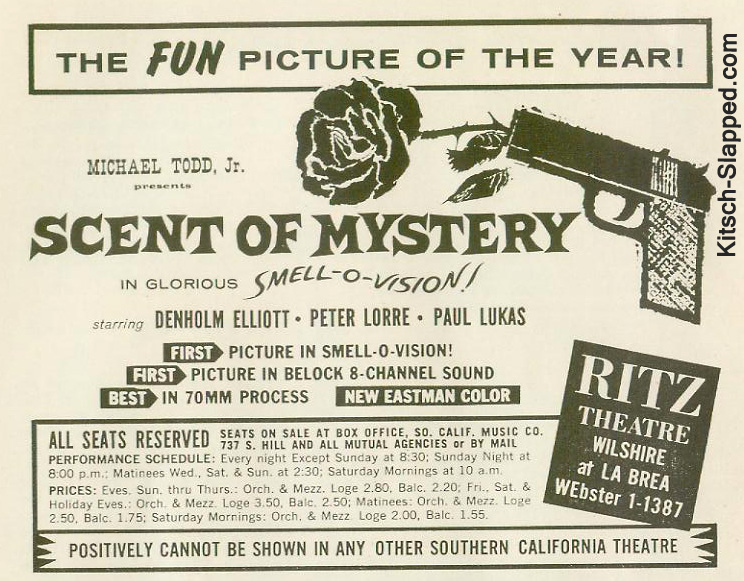
As such, it can be explained as the numerous and varying attempts of movie theaters and producers to provide an enriched experience of watching movies – by releasing scents/aromas related to what they view on the screen. Various movie theaters and producers have tried many methods to reproduce the smell of what is being shown on screen. Of these, Smell-O-Vision gained distinction because it worked for some. Note that it worked “only for some”. It was a failure, but when discussing digital scent technology, it becomes necessary to explain what Smell-O-Vision is.
What is Smell-O-Vision?
It was a system designed to release odor so viewers could smell what they were seeing on the screen. Pipes connected to individual theater seats released the appropriate smell in a timely and controlled manner.
Unfortunately, the system did not work as anticipated. The audience complained that a distracting hissing noise accompanied the release of the odor. Also, there was a significant time mismatch between the on-screen scene and the aroma experienced. In some parts of the theater, the smell was too faint to be recognized.
Working On Digital Scent Technology: Current Hurdles
A question arises here: even after forty years since we put a man on the moon, why does the ability to reproduce odor effectively in movie theaters still elude us?
One of the major reasons for this is that, compared with the other senses, the sense of smell is less well understood. We perceive smell in the same way we perceive any other sense; odor is detected by distinct sensory cells, which predominantly reside in a cavity at the back of your nose. A message is sent to the brain as soon as these cells detect odor molecules. Unfortunately, we still do not have a clear picture of how sensory cells perceive odors and how the brain differentiates among odors. This severely restricts our ability to build a technology that effectively reproduces odor.
Other challenges seem mundane but are tricky nonetheless when it comes to introducing fragrance in movie theatres. For instance, how do you ensure that the odor is uniformly distributed throughout the theatre in sufficient quantity to be noticed by all viewers simultaneously? It also needs to be ensured that the time at which an odor reaches a viewer exactly coincides with the scene being shown on the screen, and that the smell quickly dissipates to make way for the next odor.
Research On Digital Scent Technology – Can It Work?
Many companies are working on digital scent technology. This will allow us to sense, transmit, and reproduce smell digitally. A notable example is “The Scent Dome” which is being tested by a UK-based internet service provider called Telewest Broadband. The device is about the size of a teapot and can reproduce around sixty distinct smells by releasing particles from its twenty liquid-filled odor capsules. Computers using this device will be equipped with software to recognize odor-identifying codes embedded in a digital file that can be transmitted via the Internet.
Digital scent technology can immensely influence the future of a plethora of industries, including but not limited to movies, marketing, education, games, and music—if only we build it right. The only problems are those listed under challenges in the above sections. Once researchers can provide instant, uniform transfer and rapid dissipation of scent, digital scent technology might work better. That, in turn, may mean some reconstruction in theaters as well.
Assisted By & With Inputs From Swagat Karnany.
