
Windows OS uses a feature of modern laptop batteries: circuitry and firmware that can report the battery’s overall health to Windows. This is reported in absolute terms as Watt-hours power capacity. Windows then performs a simple calculation to determine the percentage of degradation relative to the original design capacity. There have been reports that after upgrading their Windows OS, users received this message – Consider replacing your battery, even when the laptop has a good battery.
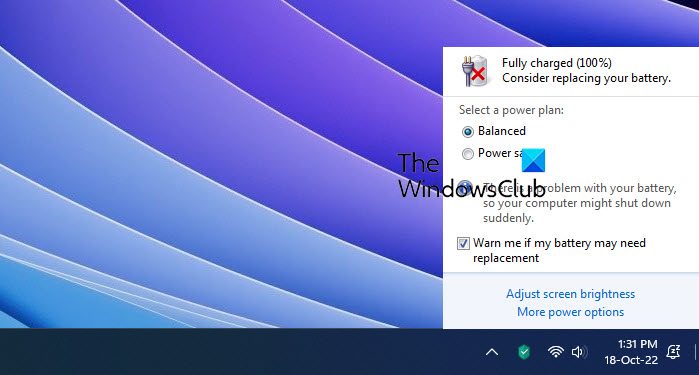
Consider replacing your battery message in Windows laptop
If this warning is displayed even if a new battery is inserted into the laptop, then a BIOS update may help you.
This problem occurs due to a defect in the system firmware (BIOS) of some notebooks.
The Advanced Configuration and Power Interface (ACPI) firmware do not correctly initialize and report the Design Capacity field of the static battery information structure that is retrieved by using the _BIF method.
Therefore, the Design Capacity reported to Windows may be much larger than the Last Full Charge capacity reported in the static battery information structure.
The Windows Battery Meter divides the Last Full Charge capacity by the Design Capacity to determine battery health. The Windows Battery Meter displays the “Consider replacing your battery” message when the Last Full Charge Capacity is less than 40% of the Design Capacity.
When this issue occurs, the Design Capacity is reported as much larger than Last Full Charge capacity. Therefore, the “Consider replacing your battery” message is always shown.
To resolve this problem, contact the computer manufacturer to obtain a BIOS update for your computer.
You should also run powercfg /battery in an elevated command prompt to generate a Battery Health Report and see if something in it helps you.
